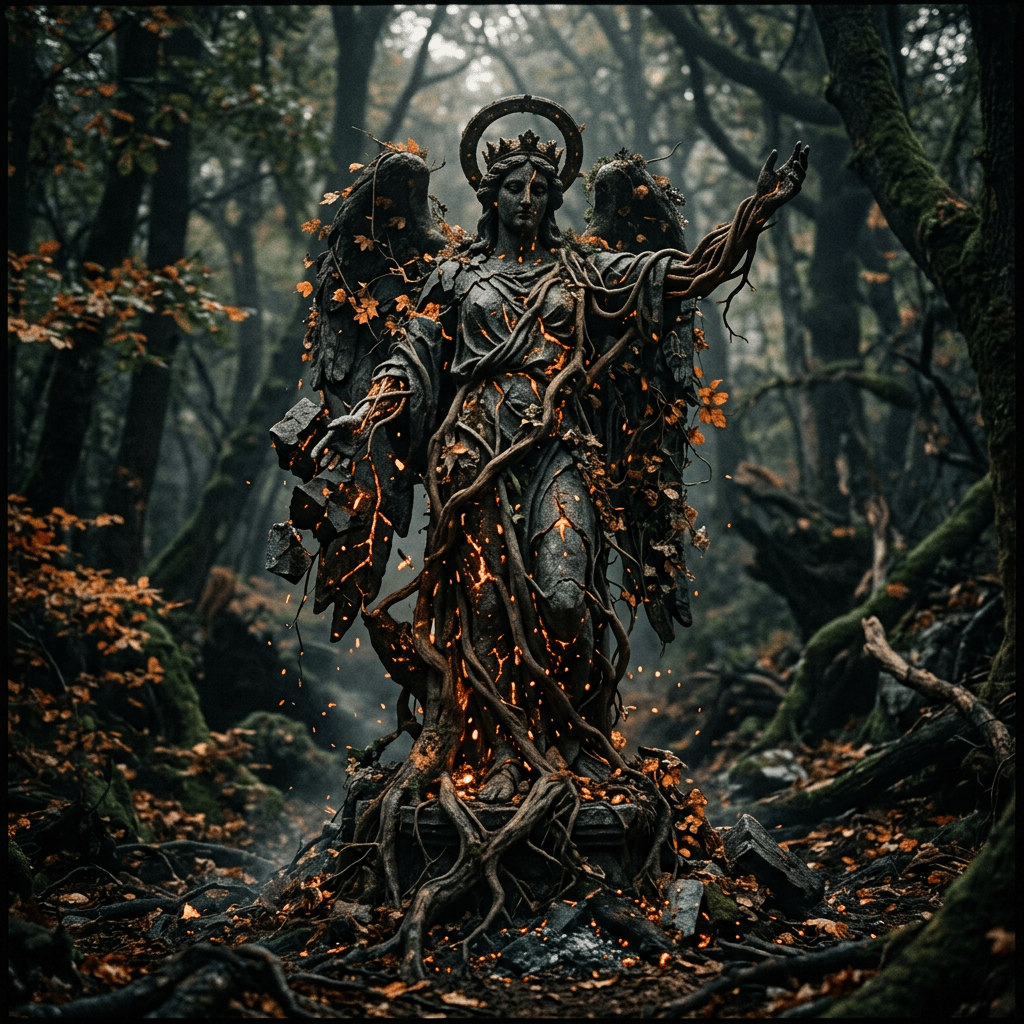
Death, myth, and the veil between the Infinite and the finite
Look at anything closely enough, and you will see its edges. This tree ends where the air begins. This hand is not that table. This person is not another. This moment is not the next. We live among distinct things, each occupying its own place, each appearing for a time and then, so it seems, disappearing.
This is not a philosophical abstraction. It is the texture of ordinary life. We love particular people, not humanity in the abstract. We mourn particular losses. We watch particular faces age. We experience the world through finite beings, each separated from the others by boundaries that seem perfectly real.
And we do not experience this finitude as neutral. We experience it as vulnerability. We look at a flower and know it will wilt. We look at a child and know they will grow old. We look at ourselves and know that one day we will die, that the particular form in which we now exist will disappear.
This is where the ancient question begins. Why must things disappear? Why must what we love be subject to loss? Why is life marked by suffering and death?
For the believer, the question often becomes, “Why would an infinite and good God allow this?” For the non-believer, the question remains, even without God: why should reality contain beings that can suffer, lose what they love, and cease to exist? The answers may be radically different, but the experience that gives rise to the question is shared.
Perhaps this is why human beings have always told stories about gods who die.
The First Images
Long before philosophy tried to define Being, myth was already struggling with the relation between unity and multiplicity, life and death, permanence and loss. Across very different traditions, we encounter divine figures who are sacrificed, dismembered, brought into the realm of mortality, or whose death somehow makes life possible.
Osiris is dismembered. Dionysus is torn apart. In other traditions, the divine is sacrificed so that the world or human life can emerge. These stories cannot simply be reduced to one another, and their religious meanings are very different. Yet they seem to preserve a remarkable intuition: the appearance of the many somehow passes through a rupture of the One.
The world does not appear in these myths simply as something added alongside the divine. Something happens to the divine itself. The whole is broken, sacrificed, or withdrawn, and from this the world of distinct beings emerges.
We should not mistake these images for philosophical explanations. But neither should we dismiss them as primitive. They may be giving symbolic form to a problem that philosophy would later struggle to formulate conceptually: how can there be a multiplicity of finite beings if reality is ultimately grounded in what is whole and undivided?
The image of the dying or dismembered god may be one of humanity’s oldest attempts to approach that mystery.
The Divine Enters the Finite
Christianity gives the question another, even more extraordinary form. God does not merely create the world from outside it. God enters it.
God becomes flesh.
Whatever one makes of the theological doctrine, the image itself contains a profound tension. The Infinite appears within the finite without simply becoming finite. Christian thought expresses this through the doctrine of the two natures of Christ: the divine and the human are united without the divine being reduced to the human.
The paradox becomes still more striking in the Eucharist. The divine is not encountered only by leaving the finite behind. The body of Christ is taken into the body of the believer. The Infinite is encountered through bread and wine, through flesh, through a particular human life.
The point is not to turn these doctrines into disguised philosophy. Their theological meanings are richer and more specific than that. But they preserve an intuition that will matter for our question: the finite does not necessarily exclude the Infinite.
And then comes the Cross.
God dies.
Yet Christianity refuses to let death have the final word. The one who dies rises; the body that is broken is also the body that is given. The divine enters death without being overcome by death.
The image therefore contains a paradox that will accompany us through the rest of the question: something can appear to die without the divine itself being finally undone.
From Myth to Philosophy
Philosophy eventually tries to think what myth had represented in images and what theology had expressed through narrative and doctrine.
Parmenides gives the problem its most uncompromising formulation: what is cannot come from nothing and cannot become nothing. Yet our experience seems to confront us constantly with birth, change, and death. Things appear, disappear, and seem to be replaced by other things.
Plato responds by distinguishing the enduring intelligible from the changing sensible world. The Ideas provide permanence while the world of experience remains subject to change and decay. The problem, however, does not disappear. It becomes the problem of how the eternal relates to the finite and changing.
That problem continues to return in different forms throughout philosophy: the necessary and the contingent, eternity and time, Being and becoming, the Infinite and the finite.
What matters for our question is this: the disappearance of a finite being seems to us to mean more than a change in appearance. We experience it as loss, as absence, sometimes as annihilation.
The finite does not merely appear as limited. It appears as something that can be lost altogether.
And this brings us to a deeper question.
The Veil
Why should finitude carry the threat of annihilation in the first place?
Perhaps an assumption is hidden within our ordinary way of seeing. Because this thing is not the whole, we begin to experience it as separate from it. Because the tree is not the stone, we begin to imagine that the tree stands on one side of Being and everything else on another.
We move, almost imperceptibly, from distinction to separation. But these are not the same.
The tree must be distinct from the stone for the tree to appear as this particular tree. A person must be distinct from another person for either to appear as a particular individual. Finite determination requires difference.
Yet difference does not by itself imply separation from Being.
This is where the relation between the Infinite and the finite becomes unavoidable. If the Infinite appeared immediately and completely as the whole, there would be no distinct finite determination appearing as such. There would be no “this” and “that” in the sense in which we experience them. The world of multiplicity would not appear as a world of distinct beings.
For the finite to appear as finite, therefore, the Infinite cannot appear immediately as the whole. It must be veiled.
This veiling is not a failure of the Infinite, nor a punishment, nor an accident. It is a condition of possibility for multiplicity itself. The Infinite does not withdraw because it is diminished or reluctant; it allows the finite to emerge precisely by not presenting itself as the totality in every finite determination.
This does not mean that the Infinite disappears, becomes smaller, or is divided into pieces. It means that no finite determination can contain or display the whole. The tree appears as tree, not as the totality of Being. The person appears as this person, not as the whole.
The finite requires the Infinite to be veiled, but the finite could not exist without the Infinite.
And this is where the old image of divine dismemberment begins to acquire its philosophical force.
The Dismemberment of God
There is a disturbing image at the heart of this problem: the image of the divine whole no longer appearing as an undivided totality. In Severino’s language, this becomes the “dismemberment of God.” The expression points toward a necessity: the world of distinct beings can appear only if the whole is veiled, so that the finite can emerge as finite.
Only if the divine is, in this sense, dismembered can the world begin to appear; not because the Infinite is literally broken, but because it no longer presents itself immediately as the whole.
The expression must not be taken to mean that the Infinite is literally broken into finite pieces. If that were so, the Infinite would simply have become finite. The dismemberment belongs to the way the whole appears through finite determinations, not to the destruction of the whole itself.
The tree is not a piece of a broken God. Neither is a human being. The world is not made from fragments left over after the Infinite has been destroyed. The finite appears as finite because the whole does not appear immediately as the whole.
The veil does something paradoxical. It makes multiplicity possible while also making the Infinite difficult to recognize. And here the possibility of nihilism enters.
Once the finite is experienced as separate, its finitude can be interpreted as contingency. Once contingency is assumed, disappearance can be interpreted as annihilation. The distinction that was necessary for the appearance of the finite becomes a perceived separation in Being itself.
The veil becomes a wall.
That is perhaps the decisive movement in the history of nihilism: not the discovery that beings are finite, but the interpretation of finitude as the possibility of nothingness.
Why Evil?
We can now return to the question with which we began. Why suffering? Why death? Why must what we love be vulnerable to loss?
The traditional problem of evil, shaped by the Platonic distinction between the perfect and the changing world and later transformed within Christian theology, asks why a perfect God would permit an imperfect world. But perhaps that question already assumes a separation between God and world, Infinite and finite, as though two independently existing realities had first been established and we were then required to explain their relationship.
The deeper question may be prior to that one: how can the Infinite appear as finite at all?
If finite beings are to appear as finite, they must appear in distinction from one another. They cannot appear as the immediate totality. The whole must be veiled in order for the particular to appear as particular.
But this does not mean that the finite is abandoned to nothingness. The necessity of finitude is not the necessity of annihilation. The necessity of distinction is not the necessity of separation from Being. And the fact that something is not the whole does not mean that it stands outside the whole.
This may be why the problem of evil is so intractable. We experience suffering and death within a world of finite beings, but we silently add another judgment: that the finite can ultimately be lost into nothingness. We are confronting not only suffering itself, but our interpretation of what suffering and death mean. The experience of loss is compounded by the conviction that loss is absolute.
This does not make suffering unreal. It does not make grief less painful or death less devastating. It simply asks whether what appears as loss has been correctly understood. If the finite was never separate from Being in the first place, then its disappearance from our view may not be its disappearance from reality. The grief remains; the interpretation of that grief as evidence of ultimate annihilation may not.
The God Who Dies—and Does Not Die
We can now return to the image with which we began. The God who dies is the God who must cease to appear as the undivided whole for the finite to appear as finite. And the God who does not die is the Infinite that no finite appearance can destroy.
The two statements do not contradict one another once we distinguish the level of appearance from the level of Being. What appears as division need not be a division of Being itself. What appears as the disappearance of a finite being need not establish its passage into nothingness.
The Infinite is veiled in the finite, but it is not absent from it.
This also allows us to see the religious images differently. The sacrificed god, the dismembered god, the incarnate God, the crucified God: these are not simply failed attempts to explain the world. They are symbolic ways of approaching a problem that is extraordinarily difficult to express conceptually.
How can the One appear as many without ceasing to be One? How can the Infinite appear finitely without becoming finite? How can death appear without having the power to undo Being?
Myth gives these questions bodies and stories. Theology gives them doctrines and mysteries. Philosophy tries to give them concepts. Each preserves something, but also encounters its own limits.
Perhaps the task is not to choose one language and dismiss the others, but to see what they were all struggling to bring into view.
And this is why the image of God’s death remains so powerful. It gives form to the apparent disappearance of the whole within the multiplicity of finite things. Yet the death cannot be ultimate, because the Infinite cannot be destroyed by any finite appearance.
The veil can hide the whole, but it cannot destroy the whole.
We began with the ordinary experience of finitude: the edges of things, the vulnerability of what we love, the certainty of death. We followed that experience into myth, where gods are sacrificed and dismembered; into Christianity, where God enters flesh and dies; and into philosophy, where the relation between the eternal and the finite becomes a conceptual problem.
Perhaps what all these attempts have been circling around is not simply the question of why we die, or even why evil exists.
It is the stranger question beneath them: what is the relation between the Infinite and the finite?
The finite is not the Infinite. But neither is it outside the Infinite.
The Infinite must be veiled for the finite to appear. Yet nothing finite can undo the Infinite.
And the God who dies is therefore also the God who does not die: not because death is denied, but because what appears to us as the death of Being never had the power to turn Being into nothing.


Leave a Reply