Category: Eternity
-
The Infinite Unveiling: Death, Contradiction, and the Eternal Horizon
Death has often been imagined as the ultimate threshold. It is the point at which life ends, the moment when we supposedly pass into nothingness, or, in religious traditions, the gateway through which the veil of this world is finally lifted and eternity is revealed. There is something deeply understandable in this intuition. As long…
Written by

-
Origins, Causation, and Eternity: What Does a Beginning Really Mean?
We tend to speak of reality as though everything must have a beginning. The universe began. Life began. Each of us began. And behind these statements there seems to be an obvious picture: before something existed, there was nothing, and then, somehow, that something appeared. Three very different accounts of reality are often brought into…
Written by
-
Eternity in Everyday Life 3: Beyond Division
The Persistent Shadow of Hierarchy Humanity has long measured itself through distinctions. Kingdoms and empires separated the civilized from the barbarian. Colonial systems ranked peoples according to origin, appearance, or customs. Even where such structures have been challenged, the impulse behind them persists in more subtle forms. National pride, inherited prejudice, and unspoken assumptions continue…
Written by
-
Eternity in Everyday Life 2: The Eternal Person
Age and the Illusion of Hierarchy In our world, time is not merely a measure of duration. It becomes a scale of value. Age, like wealth or beauty, is arranged into a hierarchy. The child is regarded as incomplete and in need of formation. Youth is celebrated as vigor, promise, and possibility. Adulthood is valued…
Written by
-
Eternity in Everyday Life 1: Beyond Comparison
Introduction – A World of Comparisons We live in a world addicted to comparison. Every aspect of human life is placed on a scale: beauty, intelligence, wealth, morality, success. We measure ourselves and others constantly. Am I better? Am I worse? Am I improving? Declining? Even in matters of virtue and spirituality, hierarchies persist between…
Written by
-
The Misunderstood Eternal – 8: The Dawning Light: How All Traditions Glimpse the Eternal
Glimpses of the Eternal in the Veil of Symbol Across the great religious traditions, one finds varied and often veiled expressions of what appears to be the eternal. Myths, symbols, and visions of the afterlife may differ in form, but their persistence across ages reveals a deeper yearning: the recognition of what does not pass…
Written by

-
The Misunderstood Eternal – 7: The Silent Testimony of the Earth: Indigenous and Ancestral Traditions
In the long and diverse lineage of human attempts to understand what lies beyond death, Indigenous and ancestral traditions form some of the most deeply rooted expressions of reverence for the eternal. These traditions – vast in number and varying in language, cosmology, and symbolism – tend not to formulate metaphysical systems in abstract terms,…
Written by

-
The Misunderstood Eternal – 6: Mystical Traditions: Veiled Unions, Unspoken Eternity
Among the world’s religious traditions, it is often the mystical branches that come closest to touching the eternal. Stripped of ritual obligations, institutional boundaries, and political frameworks, the mystical path tends to turn inward, toward contemplation, inward transformation, and a direct encounter with what it names as the divine. Often expressed in metaphors of light,…
Written by

-
The Misunderstood Eternal – 5: Buddhism and the Threshold of Illusion
Among the world’s spiritual traditions, Buddhism speaks with unmatched clarity about the impermanence of things. It does not begin from a creator, a soul, or a promise of eternal life. Instead, it begins from the simple, inescapable fact of suffering, and from the recognition that all that arises, passes away. Craving, impermanence, and illusion stand…
Written by

-
The Misunderstood Eternal – 4: The Eternal in Hindu Thought: Veiling and Unveiling
Among the world’s religious traditions, Hinduism offers perhaps the most explicit vocabulary for speaking of the eternal. Terms such as ātman, brahman, mokṣa, and saṃsāra point to a profound metaphysical intuition; one that comes remarkably close to glimpsing what the structure of Being makes necessary. Yet, as with all traditions, this truth often appears alongside…
Written by
-
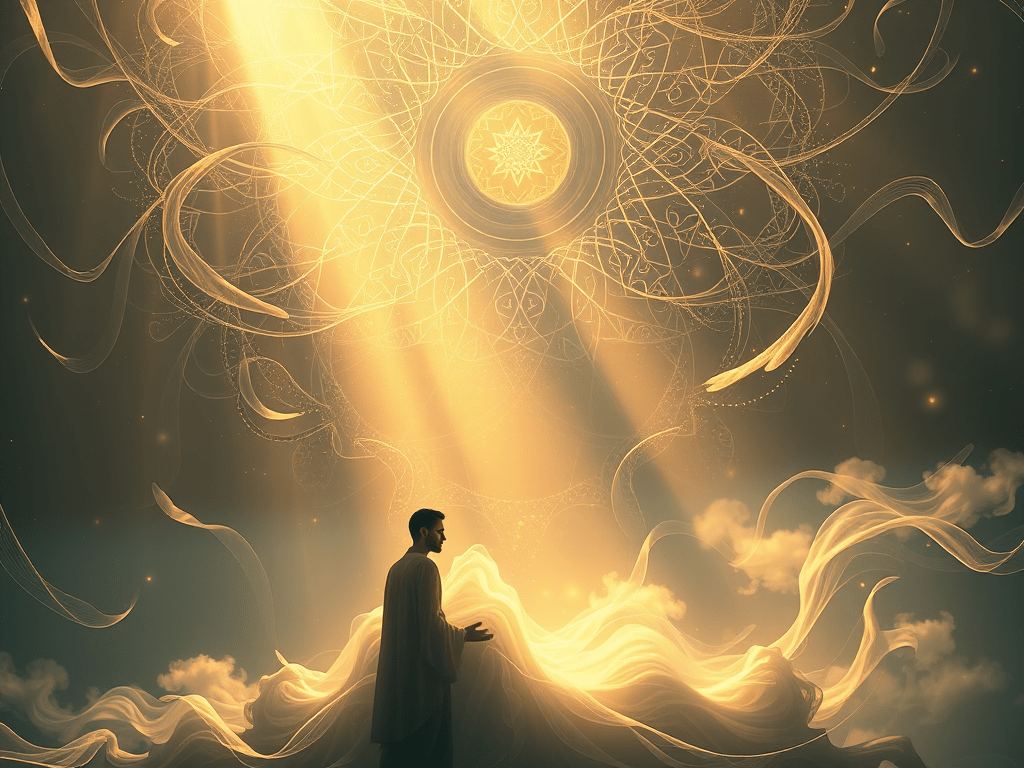
The Misunderstood Eternal – 3: Islam and the Structure of Being: Submission, Eternity, and the Necessity Beyond Will
Islam begins not with speculation, but with submission. The central act of faith is not the search for self-fulfillment, nor a quest for union in the mystical sense, but the recognition of the utter transcendence of Allah, and the call to surrender before what infinitely exceeds human comprehension. The very word Islam means “submission”—not as…
Written by
-
The Misunderstood Eternal – 2: Christianity and the Eternal Structure of Being
The Intuition of Glory Christianity, more than any other tradition in the Western world, has developed the language of glory, salvation, resurrection, and eternal life. These are not accidental features of its doctrine, but expressions of a profound intuition that human life is not reducible to the temporal, the finite, or the perishable. The Christian…
Written by

-
The Misunderstood Eternal – 1: Why Eternity Cannot Begin After Death
Religious traditions throughout history have often spoken of an afterlife, a life beyond this one, where the soul continues, ascends, or is reunited with the divine. These visions are rich with symbolism and, in many cases, carry a deep and sincere intuition: that existence does not end with death, that there is something beyond the…
Written by