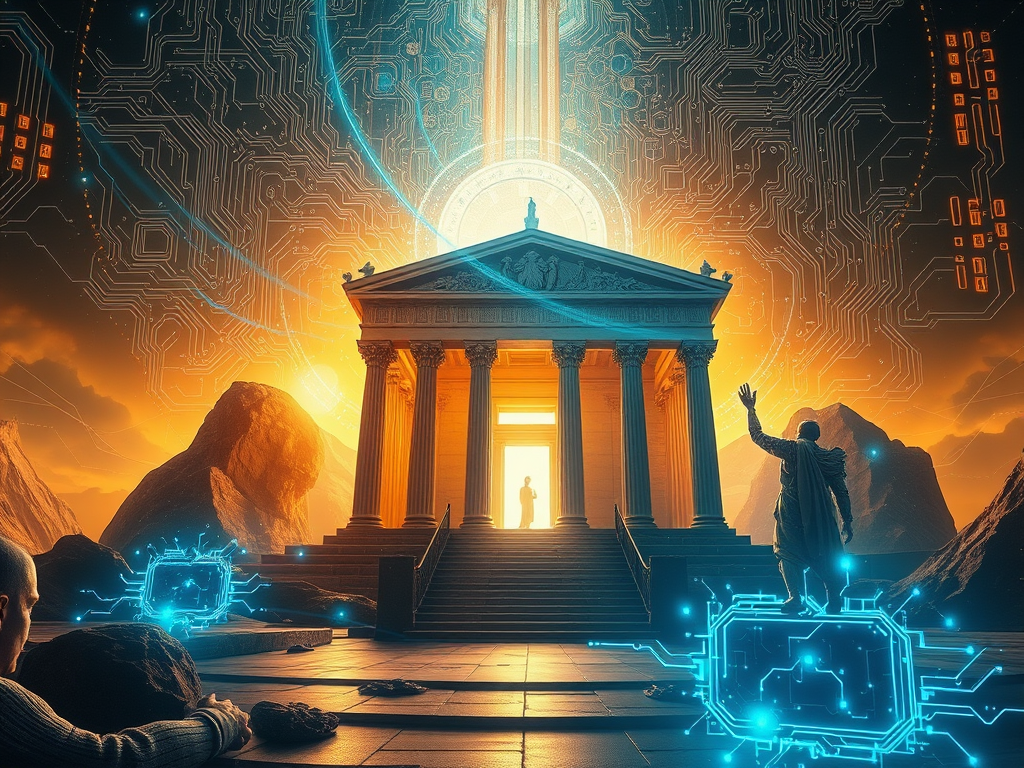
Throughout history, humanity has shaped its understanding of existence through various grand narratives, each attempting to explain the nature of reality and the role of human beings within it. These narratives have evolved—from religious explanations rooted in an eternal divine order, to secular philosophies grounded in naturalism, to the nihilistic skepticism of the modern era.
However, the most recent and pervasive turn in this unfolding trajectory is a devotion to technology as the ultimate means of shaping and transforming the world. Yet, this devotion reveals itself as the last expression of an erroneous belief in change, and ultimately, humanity may come to face the limits of this worldview. The Structure of Being provides a framework that critiques the assumption of transformation, instead asserting the eternal and unchanging nature of reality itself.
Religious Meta-Narratives: The Eternal Divine Order
In ancient and medieval thought, religious meta-narratives provided humanity with a framework for understanding existence. These narratives posited that the world was created by an eternal, transcendent being—whether God, Brahman, or another divine entity—and that all of reality was ordered and directed according to divine will. Change, in this context, was understood as part of a larger, divinely-ordained plan. Creation and existence were seen as expressions of an unchanging, eternal truth.
These religious narratives were the first manifestation of an understanding of being as eternal. Even though religion described the world in terms of creation and transformation, the underlying belief was that all change ultimately had its origin in something immutable—the divine essence or eternal logos. Despite the seeming temporality of human life, there was an implicit belief in an unchanging, divine order.
The Rise of Secular Thought: From Metaphysical Foundations to Materialist Assumptions
With the emergence of modern thought, religious meta-narratives were increasingly challenged by secular perspectives. Thinkers such as Descartes and later the materialists of the Enlightenment sought to explain existence through reason, observation, and empirical investigation. While this shift introduced valuable methodologies, it also marked a deeper movement away from the recognition of being’s eternal nature. The assumption that reality unfolds through transformation became central to the scientific worldview.
This materialist framework, though framed as progress, was not a genuine advance but rather an extension of the belief in becoming. The assumption that life and reality emerge through modification reinforced the illusion that transformation is real. While Darwinian evolution later embodied this assumption in biological discourse, the deeper issue remained: the belief that beings can transition from one state to another contradicts the eternal necessity of all that is.
The Death of God: Nihilism and the Collapse of Grand Narratives
Nietzsche’s declaration that “God is dead” signaled a profound shift in human thought, marking the collapse of traditional religious narratives and the search for objective meaning. With the death of God, the underlying nihilism came to full bloom, expressed in the belief that life has no inherent meaning, purpose, or value. In a world devoid of divine or metaphysical certainties, humanity was left to face the meaninglessness of existence. This nihilism was compounded by the rise of relativism—the idea that truth is subjective and contingent, varying from culture to culture and person to person.
Nihilism represents the recognition of the limits of human understanding when grounded in the belief in becoming. The assumption that the world is in flux—whether through religious interpretations of divine will or through scientific models of progress—ultimately leads to a confrontation with the impossibility of true change. The world, in this view, becomes nothing more than a series of fleeting appearances, with no underlying permanence or unity. This realization, though deeply disorienting, is necessary for the human mind to recognize the limitations of its understanding based on change.
Postmodernism: The Fragmentation of Truth and the Embrace of Technological Devotion
As the modern era gave way to postmodernism, the crisis of meaning deepened. The postmodern world rejected grand, universal narratives and embraced fragmentation, relativism, and skepticism. The idea that all truth is contingent, constructed, and subject to interpretation became a dominant theme in intellectual circles. Without a fixed metaphysical or religious center, meaning became endlessly subjective, and the human search for truth seemed increasingly futile.
In the midst of this crisis, technology began to emerge as a new metanarrative—a new faith system offering the possibility of progress, control, and transformation. No longer simply a tool, technology became the only avenue for humanity to shape its future and overcome the limitations of nature, biology, and even the human condition itself. Techno-utopianism arose, with the belief that through technological innovation, human beings could transcend their mortality, master their environment, and even achieve perfection.
From the Structure of Being perspective, however, technology represents the final expression of the desire to transform and change—a desire rooted in the metaphysical error of believing that becoming is possible. The devotion to technology, while promising to reshape the world, ultimately reflects the same erroneous belief in transformation that has characterized previous worldviews, from religion to naturalism to postmodernism.
The Limits of Nihilism: The Unveiling of Destiny and Eternal Being
Despite the promises of technology, there is an increasing recognition of its limits. While technology provides solutions to many of humanity’s immediate challenges, it cannot address the fundamental existential questions about meaning, purpose, and value. The technological revolution, despite its advances, does not offer a final answer to the deepest questions of human existence.
In the Structure of Being framework, the realization that nothing truly changes may initially seem unsettling, but rather than being a point of despair, it marks the beginning of a deeper understanding: that true change is impossible. This insight reveals the eternal, unchanging nature of reality, offering a profound shift in perspective that moves beyond the misinterpretation of transformation. The belief in transformation—whether through religious providence, scientific progress, or technological advancement—is recognized as fundamentally mistaken.
At this juncture, the Structure of Being offers a path forward: a return to the recognition of an eternal order that underlies all reality. Rather than seeking change or progress, humanity must turn toward understanding the unchanging essence of being itself. The technological era, with all its promises of transformation, might eventually reveal its own limitations, leading to a profound shift in thought. When the paradise of technology is reached and humanity believes it has attained control, it will find that this paradise cannot provide certainty nor eliminate existential anxiety. At this moment, humans may turn to ask the right questions, recognizing that the world does not need to change, but that the misinterpretation of change can be dissolved to reveal the eternal and immutable structure of being.
Conclusion: The Unfolding of Destiny
In the unfolding trajectory of thought, from religious meta-narratives to the rise of secularism, the death of God, the nihilism of postmodernism, and the technological devotion of our time, the limits of the belief in change and becoming are becoming apparent. The Structure of Being offers a framework in which the apparent transformations of the world are understood as misinterpretations, with the true nature of existence lying in the eternal, unchanging structure of being itself. The future of thought, then, may not lie in the endless striving for change but in the recognition of the eternal destiny that underlies all things—a destiny that reveals itself when the misinterpretation of becoming is finally overcome.


Leave a comment