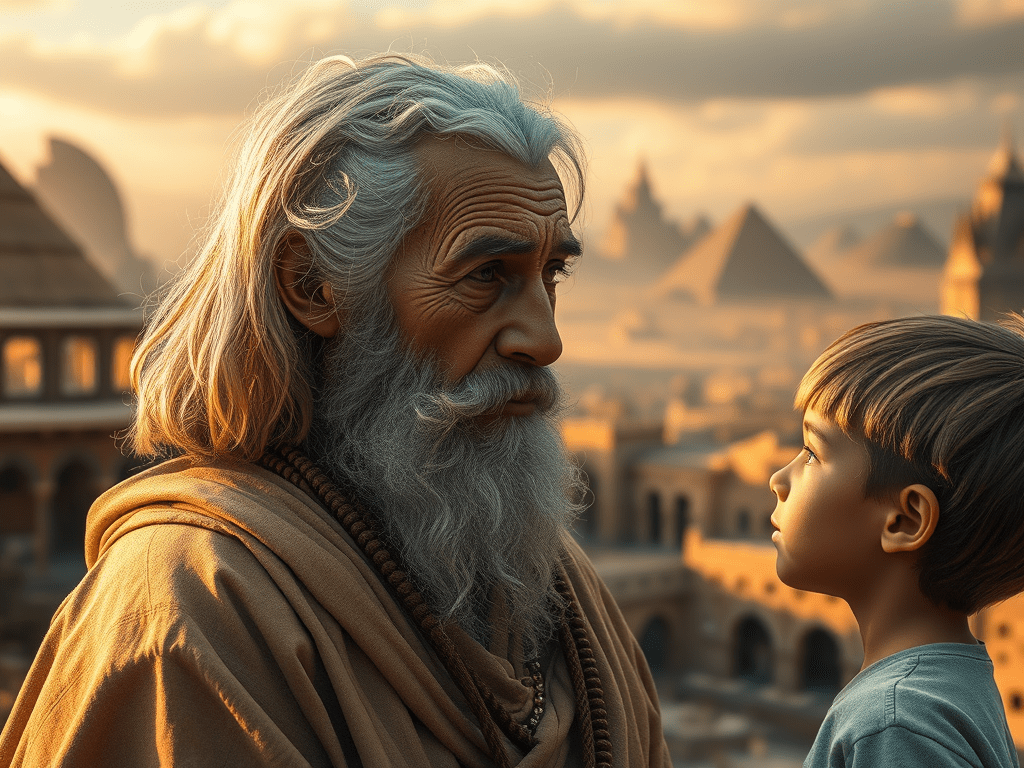
Modernity believes in irreversibility. It tells us that what is left behind stays behind, that time flows in one direction, that progress renders the past obsolete. In this faith, youth replaces age, technology replaces tradition, the image replaces the word. And yet, despite its power, this movement is haunted. For even in the midst of innovation, something old—infinitely old—returns.
What returns is not nostalgia. It is not a desire for old customs or lost rituals. What returns is Being. What returns is truth.
The Contradiction of Generational Rupture
The modern myth tells each generation to sever itself from the last. This is framed as freedom. But beneath the rhetoric lies a contradiction: the very act of rejecting the past presupposes it. To stand apart from one’s ancestors is still to stand in relation to them. To rebel is to acknowledge what one claims to overcome. The myth of autonomy collapses into dependence.
No generation creates itself. No thought arises from nothing. All becoming presupposes Being. And Being does not age.
Thus, what appears as rupture is in truth the unfolding of necessity. The very denial of tradition becomes, over time, the occasion for its rediscovery. Youth, alienated from inheritance, begins to hunger not for novelty, but for meaning. And meaning, inevitably, leads back—not to a temporal past, but to the eternal structure from which all meaning flows.
The Reappearance of the Eternal
The return of the ancients is not a historical event. It is a metaphysical certainty. Because Being is eternal, it cannot be surpassed. Because truth is necessary, it cannot be replaced. When the world forgets, the eternal does not disappear—it waits. And in times of crisis, collapse, or exhaustion, it reappears—not as memory, but as presence.
This is not a return to particular cultures, doctrines, or institutions. It is the return of what made them possible. What returns is the recognition that the human being is not a contingent project, but an eternal appearance. That thought, language, love, suffering, and death all participate in a structure that does not change. That the truth is not ahead of us, but always already present.
A New Encounter Between Youth and Age
The generational divide has become a metaphysical wound. Youth is praised but directionless. Age is scorned but forgotten. And yet beneath the surface, something deeper stirs. In some young, a quiet reverence reawakens. In some elders, a silent strength remains. And between them—if they can meet not in time, but in truth—a new relationship is possible.
This meeting is not about roles or authority. It is about recognition. To see the other as eternal is to see beyond age. It is to know that we are not temporary fragments, but necessary parts of the Whole. That we have not come from nothing, and we do not end in nothing.
The return of the ancients is the return of this knowledge.
Conclusion: The Memory That Cannot Die
This series has traced the myth of progress not to condemn modernity, but to understand its necessity—and its limits. The forgetting of Being, the worship of novelty, the rise of blame, the fragmentation of image, the illusion of autonomy, the disdain of simplicity—all of these are appearances. And because they appear, they belong. But what appears in this forgetting is also the truth of what cannot be forgotten.
The eternal structure of reality is not behind us. It is not in the future. It is always. And every generation, however lost it may seem, is called—by its very existence—to rediscover this truth.
The ancients return not because we go back to them, but because they never left.


Leave a comment