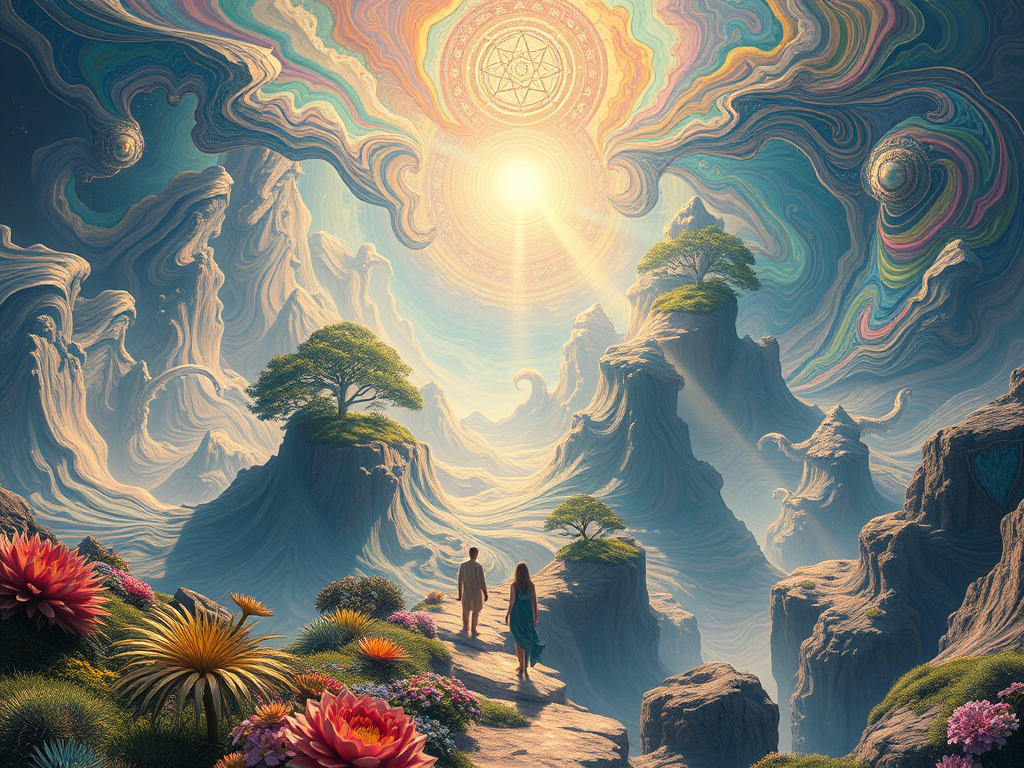
The psychedelic experience has returned to the center of contemporary spiritual and therapeutic discourse. In this space of intense inner encounter—visions, insights, feelings of oneness or timelessness—many report a sense of coming home, of having touched something profoundly real. And perhaps they have, in some way. These moments can feel like windows into a deeper order, into something that transcends ordinary perception. But this raises a deeper question, one that rarely enters the conversation: Is experience itself truth? Or more precisely, what is it that makes an experience true?
This question is not meant to diminish the value of altered states, but to elevate the inquiry they provoke. If psychedelics offer glimpses of something beyond the ordinary, we owe it to those glimpses—and to ourselves—to ask what they truly reveal. What do these experiences point toward? And where do they fall short?
Glimpses and Mirrors
There is no doubt that psychedelic experiences often awaken something in us—something ancient, intuitive, and difficult to express. Many report a felt sense of unity, timelessness, the dissolution of boundaries, or encounters with what they describe as love, truth, or the divine. These descriptions are not random. They echo themes found in mystical traditions, philosophical speculation, and even metaphysical certainties.
And yet, the psychedelic state is also deeply shaped by context: by one’s expectations, culture, beliefs, and psychological landscape. A vision of Christ, of light-beings, of geometric symmetries, or of the self dissolving into nature—all can arise depending on what the mind brings to the threshold. These experiences are not fabrications, but they are not neutral either. They are expressions, appearances formed within a web of personal and historical meaning.
To honor the experience is not to take its content as literal. It is to recognize that the experience, like a dream or a symbol, may mirror something deeper—but it is not itself the structure of that depth.
Experience Is Not Truth
This is where the distinction becomes essential. Experience is the appearing of something—it opens a space in which something comes into view. But what appears is not necessarily what is eternal. A vivid encounter with unity may correspond to a metaphysical truth—but unless that truth is grasped in its necessity, it remains provisional, open to reversal, even confusion.
Emanuele Severino’s philosophy clarifies this point with precision. Truth is not what appears most vividly, but what cannot not be. That which necessarily is does not appear only under special conditions or through chemical alteration. It is always already present—it is Being itself, eternally appearing as thought.
This is not to say psychedelic experience is illusory. Rather, it is to say that without the recognition of necessity, the experience cannot ground itself. It may suggest, hint, or symbolically resonate with truth, but it remains within the flux of becoming unless it is interpreted through the lens of what must be.
Intuitions of the Eternal
Many of the core themes in psychedelic experience—unity, timelessness, the illusion of the separate self—are intuitions that align, in part, with the eternal structure of Being. These are not errors. They are meaningful indications, expressions of a deep-seated human longing to rediscover what we are and have always been.
But to stop at the feeling is to risk mistaking the symbol for the substance, the sign for the truth. A person may experience ego dissolution and feel liberated—but unless they recognize that the self is eternal and cannot cease to be, the experience remains ambiguous. Likewise, a vision of love or light may be beautiful and transformative—but unless one sees that Being itself is love, light, and necessity, it remains an image, not yet the truth.
From Awakening to Understanding
The value of psychedelic experience lies not in what it shows, but in what it awakens. It can shake the boundaries of a narrow self, disrupt mechanical thought, soften the illusions of time and fear. It can open the heart to mystery. But these openings must be followed by discernment—a turn toward that which does not change, does not vanish, and is not dependent on perception.
This is not a dismissal of the psychedelic path. It is an invitation to deepen it. To see that the real transformation comes not from what one sees under the influence, but from what one comes to recognize as eternally true. The task is not to reject experience, but to move beyond it—toward the unveiling of what cannot become, what does not pass away.
Toward the Rediscovery of the Self
In this sense, psychedelic experience is not an endpoint but a threshold. It can mark the beginning of a journey from the conditioned self toward the recognition of the eternal self—the self that does not arise from becoming, but exists necessarily as part of the eternal structure of Being.
This rediscovery is not the result of an altered state but of a profound shift in vision: the recognition that we have never been contingent, that we have always already been part of the eternal.
Preview of Article 4: Healing or Hallucination? Psychedelics, Trauma, and the Eternal Self
If psychedelic experience can open us to something beyond illusion, can it also heal? In the next article, we turn to the role of psychedelics in trauma therapy and inner transformation. How do these altered states interact with our wounds? Do they truly restore us—or only offer the appearance of healing? Most importantly, what does it mean to be healed, if the self is not a becoming but an eternal necessity?
 It Is What It Is
Leave a comment