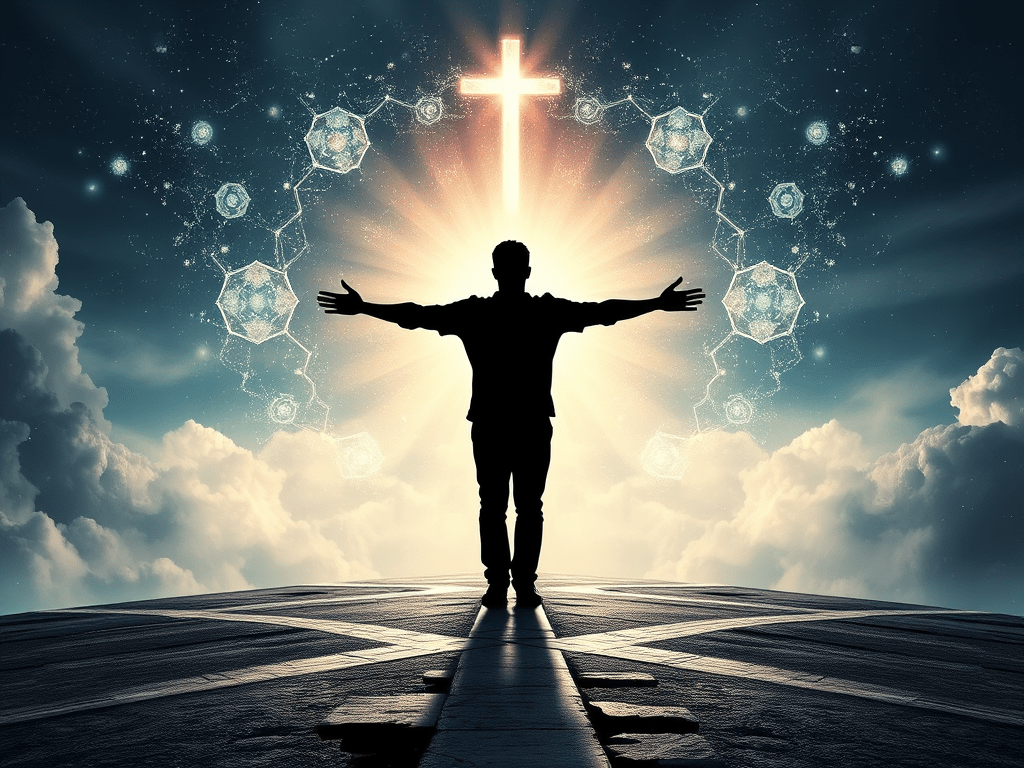
The divide between faith and reason is not only a modern dilemma—it is an ancient tension woven into the fabric of our relationship with truth. Religion, and especially Christianity, can be seen as one of the most sustained efforts in human history to reconcile what appears divided: revelation and understanding, divine mystery and human thought, faith and philosophy.
This effort, however, contains within itself a paradox. The very attempt to unify faith and reason presupposes their duality. What appears as synthesis is already a negotiation. And this tension is not a historical accident or institutional failing—it is a necessary unfolding of the structure of appearing itself.
To understand this, we must revisit the heart of religious thought—not to assess its doctrines, but to observe the structural dynamic that drives its movement: the contradiction it attempts to resolve, and the deeper unveiling that contradiction makes possible.
The Marriage of Revelation and Reason
From its earliest formulations, Christianity stood at the crossroads of mythos and logos. Emerging in a Hellenized Jewish world, it inherited two powerful traditions: the Hebrew experience of divine encounter and command, and the Greek search for rational understanding of the cosmos.
The Hebrew tradition offered a history of revelation—of a God who speaks, acts, and binds a people to Himself through covenant. The Greek tradition offered philosophy: a love of wisdom, a search for first principles, an inquiry into what is. Christianity did not reject either. Rather, it saw itself as the fulfillment of both.
Christ is proclaimed not only as the Word made flesh (Logos sarx egeneto), but also as the mystērion—a truth hidden for ages and now revealed. The early Christian thinkers, from Paul to John, do not offer a rejection of reason, nor a mere repetition of myth. They speak from within a space where divine disclosure and human reflection are inseparable.
In this way, theology was born—not merely as doctrine, but as the intellectual effort to think the revealed. Faith seeks understanding; belief seeks coherence. This is fides quaerens intellectum, faith seeking understanding, as Anselm would later put it.
But from the very beginning, this unity was not simple. It was not a harmony waiting to be affirmed, but a tension demanding to be carried. Christianity did not erase the opposition between faith and thought—it attempted to hold them together in a single gaze.
Mysticism, Theology, and Apologetics: Three Forms of Holding
As the Church matured, three broad modes emerged in its attempt to maintain the unity of faith and reason.
a. Mysticism: Faith beyond Reason
Mysticism represents the path of radical interiority. The mystic does not deny reason, but travels through it—beyond it—into a direct experience of God. In the mystical path, thought dissolves into vision; word collapses into silence. The divine is not grasped but encountered, not understood but unveiled.
From Pseudo-Dionysius to Meister Eckhart, from the desert fathers to the Eastern hesychasts, the mystics testify to a form of knowing that transcends distinction. It is not irrational but supra-rational. Yet this very transcendence confirms the split: the divine is not reached by reason, but by leaving it behind.
Mysticism preserves the unity only by bypassing the tension. It affirms the mystery at the cost of philosophy.
b. Theology: Reason Illuminated by Faith
Theological reflection attempts a more systematic reconciliation. Thinkers like Augustine, Aquinas, and Bonaventure sought not to bypass reason but to elevate it. Reason, they argue, is not opposed to faith, but fulfilled by it. Revelation becomes the light within which reason finally sees.
This approach reaches its zenith in Scholasticism, where the truths of faith are carefully ordered, clarified, and defended through philosophical precision. For Aquinas, reason and faith are two lights—natural and supernatural—both emanating from the same divine source.
But this project, for all its brilliance, rests on a fragile foundation. It requires that reason be both autonomous enough to operate and humble enough to submit. It must know its limits and yet stretch toward the infinite. The moment reason asserts itself as judge, or faith retreats into the unprovable, the balance breaks.
And inevitably, it did break.
c. Apologetics: Faith under Siege
As modernity dawned, the unity of faith and reason began to fracture. The rise of empirical science, historical criticism, and rationalism placed increasing pressure on traditional religious claims. In response, apologetics emerged as a defensive mode: an attempt to justify faith in the terms of reason.
The apologist accepts the battleground of modern reason and seeks to show that faith is not irrational. Arguments for God’s existence, for the historical reliability of scripture, for the coherence of doctrine—all become part of a rational defense of belief.
But in accepting the rules of the opponent, apologetics often cedes the very ground it wishes to defend. It places the divine under human judgment. Faith becomes plausible, rather than radiant; defensible, rather than self-evident. The mystery is domesticated in the name of credibility.
Here, the union of faith and reason is no longer a marriage but a hostage negotiation.
The Hidden Impossibility of the Union
Why does the union eventually fail? Why, despite the immense theological and mystical efforts of centuries, does the modern age see faith and reason as enemies?
Because from the beginning, the union presupposes the very dualism it seeks to overcome.
In order to reconcile faith and reason, one must already perceive them as distinct. The attempt at synthesis begins with separation. And this separation is not merely epistemological—it is ontological. It reflects a deeper rift in our understanding of Being.
Modernity did not invent the crisis of faith and reason; it revealed it. What appears as a decline from the unity of the Middle Ages is, in truth, the continuation of a deeper contradiction that was always present. The apparent harmony was only a provisional holding, not a resolution.
This is not to diminish the spiritual or intellectual greatness of theology or mysticism. It is to say that what they attempted—to think and to see the eternal within time, to articulate what transcends all articulation—was bound to expose the limits of both approaches.
The Contradiction of Appearance
Emanuele Severino helps us see that this failure is not accidental, but necessary. Faith and reason, as traditionally conceived, both operate within the horizon of becoming. They both attempt to grasp, name, or preserve what appears—as if truth were something given within time, to be held or demonstrated.
But if Being is necessary and eternal, as Severino insists, then both faith and reason, when they forget this necessity, become modes of contradiction. Faith, when reduced to belief in what might not be, affirms the possibility of non-Being. Reason, when absolutized as human mastery over truth, attempts to construct what is not self-evident.
Both thus fall into the contraddizione C: the implicit belief that Being might not be, that truth might be absent or lost.
The religious attempt to unite faith and reason must fail—not because it lacked effort or sincerity, but because it operated within the illusion that the eternal can be secured by human means.
The contradiction is not between faith and reason—but between any attempt to possess truth, and the truth that cannot be possessed.
Toward the Inevitable Collapse—and Beyond
The eventual split between theology and philosophy, between Church and science, between faith and secularism, was not the result of malice or decay. It was the necessary surfacing of the contradiction within the religious synthesis itself.
The sacred unity strained to hold two forces that, once absolutized, could not coexist. When reason claimed sovereignty, faith was relegated to subjectivity. When faith clung to certainty, reason was seen as a threat. The modern age is not the fall from a golden unity, but the unveiling of an impossible tension.
And yet, this collapse is not the end.
For just as myth gave way to philosophy—not as a rejection, but as a deeper unveiling—so too the failure of religion’s synthesis reveals a new possibility. Not a return to the past, nor a simple affirmation of one side over the other, but the recognition that both faith and reason are appearances of something deeper.
They are not origins of truth but responses to it. They are not possessors of Being, but modes of its unfolding.
In this light, the task is not to choose between faith or reason, nor to reestablish their harmony, but to witness the contradiction that appears through them—and, in that contradiction, to glimpse what is beyond them both.
The Witness of the Rift
The failure of the religious synthesis is not a condemnation of religion. It is, paradoxically, its highest gift. For in trying to hold together what appears divided, religion exposed the rift at the heart of thought—the illusion of mastery, the fear of loss, the longing for presence.
This exposure is painful, but necessary. The collapse is not a fall from grace—it is the grace of seeing more clearly. Faith, stripped of certainty, becomes the openness to what is. Reason, deprived of control, becomes the longing to understand without domination.
And in that shared fragility, a new space opens—not for synthesis, but for truth’s appearing.
This is the path we now walk—not back to the unity we imagined, but forward to the necessity we have not yet dared to see.
Next: The Secular Unraveling – When Reason Becomes Absolute
In the third article, we will follow this structural movement into the heart of modernity, where reason, liberated from faith, asserts itself as the sole arbiter of truth—only to reveal its own contradiction.
Let us proceed.


Leave a Reply