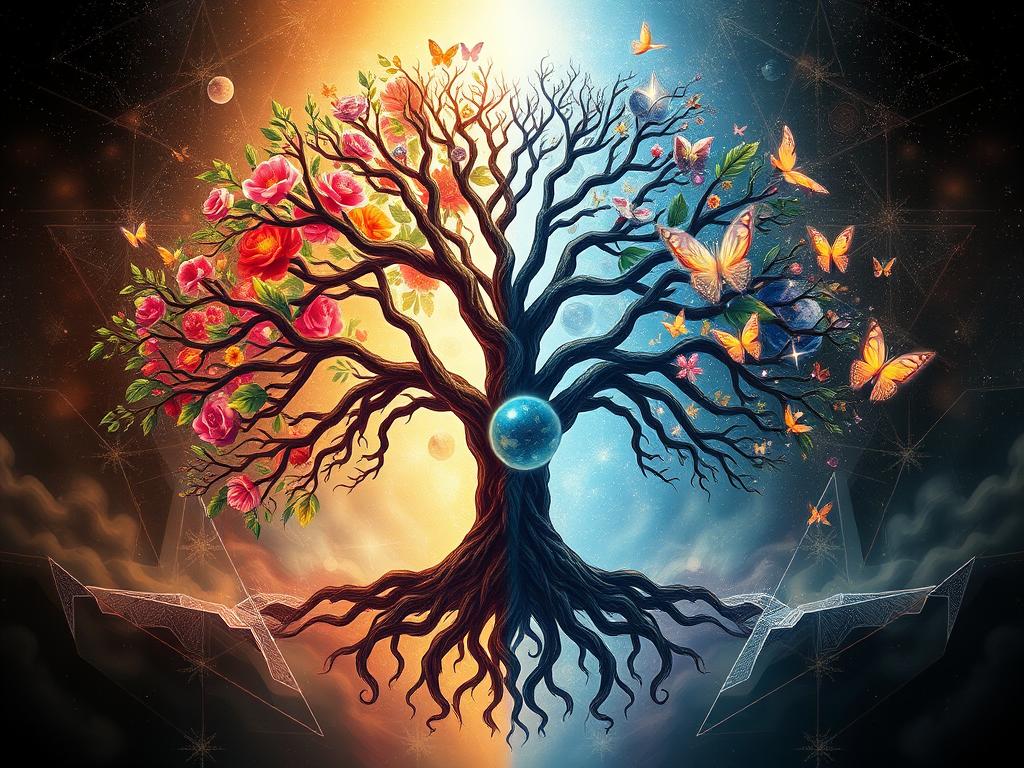
There is a fracture that haunts the history of human consciousness, a tension as old as our first questions. We have learned to call it many names: myth and reason, faith and logic, heart and mind, East and West, feminine and masculine. At its core, however, this division reflects something far more essential than cultural or historical development. It expresses a fundamental dynamic within the very appearing of truth.
We are accustomed to seeing the progression from myth to philosophy as a sign of evolution—a rise from primitive intuition to rational clarity. Myth, in this view, is often reduced to fantasy, to projection, to an early attempt to explain the world in the absence of science. Thought, on the other hand, is the mark of maturity, the awakening of reason, the triumph of the conceptual mind.
But this narrative is misleading. It conceals the fact that myth and thought are not stages of ignorance and enlightenment. They are distinct ways in which the eternal structure of Being begins to appear. Both are necessary unveilings—each bearing within it a particular relation to truth, and each, in its own way, concealing and revealing the deepest contradiction of all: the contradiction of becoming.
Myth: The World as Given
In the mythic world, there is no gap between the word and the thing, between the symbol and the reality it names. The gods are not abstract principles; they are living presences. Nature is not inert matter but sacred form. Time is not linear but cyclical, embedded in the eternal return of cosmic rhythms. To speak in myth is not to construct a model of the world but to participate in its meaning.
Myth does not aim to explain, in the way philosophy or science might. It does not seek causes behind appearances. Rather, it embodies the world as given—charged with presence, ordered by destiny, bound by ritual and story. Meaning is not discovered through analysis but is inscribed in the structure of reality itself.
We see this most vividly in religious traditions. In the Genesis account, the world is not assembled from parts, but spoken into being through divine word. In Hindu cosmology, cycles of manifestation and dissolution are not evolutionary steps, but expressions of eternal rhythms. In indigenous narratives, myth orders the land, the animals, the seasons, and human life into one living unity. Myth gives us more than a story—it gives us a place within a cosmos already filled with meaning, intention, and direction.
Even in secular modernity, myth returns under different names: the arc of progress, the triumph of the individual, the nation as destiny. These are not myths in the sense of falsehoods, but in the truer sense: they are structures of ultimate meaning that answer not just how the world works, but why we are here and what everything is for.
The mythic consciousness lives in immediacy. It does not stand apart from the world to reflect on it; it dwells within the world as an expression of its divine order. It does not ask “why is there something rather than nothing” because nothingness has not yet entered thought as a possibility. There is no sense of rupture, no awareness of contingency. Being is, and that is enough.
Yet even within myth, there are tensions. Myths often dramatize oppositions—between chaos and order, light and darkness, life and death. These oppositions do not express logical contradiction but narrative necessity. They are not puzzles to be solved but forces to be honored. And it is precisely within these dramatizations that the first signs of philosophical questioning begin to stir.
Philosophy: The Rise of the Question
Philosophy emerges when immediacy breaks. When the world no longer appears as sacred order but as something questionable, something open to analysis. The first philosophers do not aim to destroy myth, but they begin to shift its language. They ask: what is the underlying principle of all things? What is real, unchanging, eternal?
With thinkers like Heraclitus, Parmenides, and Anaximander, we begin to see a different relation to truth. No longer simply expressed through symbol and narrative, truth is now pursued through reasoning and argument. The logos becomes central—not just as speech, but as the order of thought itself.
This marks the appearance of a divide: no longer is being simply lived; it is now thought. But thought introduces separation. To think is to stand at a distance. The philosopher steps outside the ritual world and begins to examine the structure beneath. And in doing so, a new question arises—not just about the world, but about thought itself.
This movement is not a fall from unity, nor a rise into truth. It is an inevitable appearing of a deeper contradiction: the realization that things seem to come into being and pass away, and yet thought insists that what is, must be. Parmenides famously declares that “what is, is, and what is not, is not.” But how, then, can anything change? How can becoming be possible?
This is not merely a logical puzzle. It is the first appearance of a contradiction that will unfold throughout the history of philosophy and thought itself: the contradiction of trying to think being as becoming, of trying to preserve the identity of what is while admitting its change.
The Unfolding of Contradiction
Emanuele Severino has shown that the true birth of philosophy lies not in the rejection of myth, but in the exposure of the contradiction hidden within becoming. Philosophy appears when the world is no longer simply accepted as it is, but when it begins to be thought as something contingent—something that might not be, or might become otherwise.
But in this gesture, a contradiction is introduced: for if something comes into being, then it must once have been nothing; and if it passes away, it becomes nothing again. Yet how can nothing produce anything? How can what is arise from what is not?
This is the central contradiction of all becoming. And it is a contradiction that neither myth nor philosophy can fully escape. Myth obscures it by enveloping change in sacred narrative. Philosophy, on the other hand, tries to resolve it—through metaphysics, through logic, through appeals to substance or cause—but always ends up reaffirming it in another form.
Severino’s radical insight is that this contradiction is not a flaw to be corrected by better thinking. It is the very structure of Western thought itself. From Plato to Hegel, from Aristotle to Heidegger, the belief in becoming—that things can pass from being to non-being and back again—remains the foundation. And as long as this belief holds, truth itself remains hidden.
Myth and Logos as Phases of the Same Drama
Rather than viewing myth and philosophy as antagonists in a historical struggle, we must begin to see them as complementary unveilings within a single unfolding. Both are attempts to respond to the same fundamental reality: the appearing of truth within time, under the veil of change.
Myth expresses this through story, symbol, and rite. Philosophy expresses it through analysis, argument, and logic. But both are still caught in the same appearance—that Being can become, that the eternal can change, that what is can pass away.
In this sense, neither myth nor philosophy is “true” in the final sense. But neither are they simply false. Each is a necessary step in the path toward the recognition of Being as eternal, as necessary, as impossible to become otherwise. Each dramatizes, in its own mode, the contradiction that thought must eventually bring to light.
The shift from myth to philosophy is not an evolution but a revelation. Not a movement from darkness to light, but from concealment to partial unveiling. In myth, the contradiction is hidden behind the presence of gods. In philosophy, it becomes the very object of inquiry. And yet, even in exposing it, philosophy cannot yet resolve it.
This is not a failure, but a necessity. For the contradiction must appear in order to be seen. And only by being seen can it begin to be overcome.
Toward the Recognition of Being
What appears in the history of thought is not a linear progression, nor a battle between ignorance and enlightenment. It is the unfolding of necessity, the gradual unveiling of truth under the conditions of time and finitude.
The mythic world speaks truly in its intuition of sacred presence. The philosophical world speaks truly in its exposure of contradiction. But both remain within a framework that still believes in the possibility of becoming—that what is can not be, and that what is not can become.
The resolution of this contradiction does not lie in choosing one over the other. It lies in seeing that both participate in a deeper drama: the drama of Being revealing itself under the appearance of non-being.
This is the path that philosophy, at its highest, begins to glimpse. And it is the path that thought must follow—beyond the symbolic and the conceptual, beyond myth and logos, beyond the illusion of time itself.
What is needed is not a return to myth, nor a purification of logic, but the recognition of what neither myth nor philosophy could yet fully see: that what is, is eternal, and cannot become nothing. That all appearing, even the appearance of contradiction, belongs to the necessity of Being. And that the entire drama—of gods and questions, of presence and thought—unfolds within the fullness of truth, which cannot not be.
This is the foundation. From here, we will follow the unfolding of this structure in its many forms—through religion, reason, science, and self—until the contradiction no longer hides in our seeking, but dissolves in the clarity of what has always been.


Leave a Reply