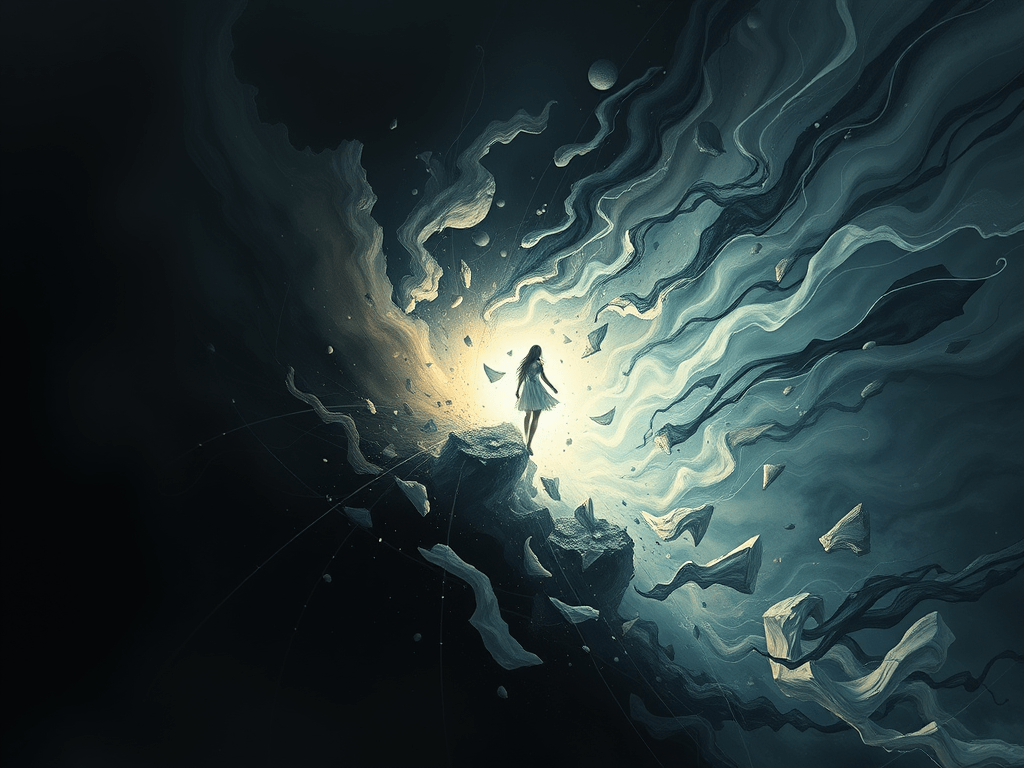
The Necessary Contradiction at the Heart of Appearance
“Truth appears in opposites.”
Meister Eckhart
Human experience seems governed by contrast. We speak of insight emerging from confusion, peace from turmoil, light from darkness. This pattern feels unavoidable, as though truth itself required opposition in order to be known. But is contradiction a feature of reality, or is it the form through which reality becomes intelligible within a finite horizon?
From a Severinian perspective, this question must be approached carefully. The issue is not whether opposites appear, but what their appearance means.
How Truth Appears
Truth does not present itself to human awareness as a finished whole. It appears in fragments, contrasts, and tensions. We do not encounter light as an isolated purity, but as what stands out against darkness. We do not recognize peace except against the background of unrest. This does not mean that reality is divided, but that recognition unfolds through distinction.
The opposition we experience is not ontological. Being itself is not split. What appears as contrast belongs to the way eternity shows itself within a consciousness that interprets being through separation, succession, and exclusion.
Ancient thinkers intuited this. Heraclitus spoke of unity in opposition. Plotinus saw multiplicity as the way the One becomes visible without ceasing to be one. Severino provides the ontological rigor behind these intuitions. Opposites do not describe the structure of being, but the structure of its appearing when being is thought as exposed to nothingness.
The Necessity of Apparent Contradiction
If being is eternal and indivisible, why must it appear fractured? Why does recognition pass through tension rather than immediacy?
Because the dominant conviction shaping human experience is that things can not be. As long as beings are understood as vulnerable to disappearance, reality must appear unstable. Within this horizon, unity cannot simply be given. It must emerge through the exhaustion of contradiction.
This is not a pedagogical strategy chosen by truth. It is the necessary consequence of how being is interpreted. A consciousness shaped by the belief in nothingness cannot immediately see eternity. It must first encounter the implications of that belief, including suffering, loss, and apparent negation.
Contradiction is therefore not a stage to be surpassed by synthesis. It is the form in which eternity appears when it is misunderstood.
History as Intensification
History reflects this structure. What is often described as progress is better understood as the intensification of internal tensions. Each attempt to stabilize meaning through partial truths eventually reveals its limits.
Myth, religion, metaphysics, science, and technology each articulate reality within a certain framework. Each framework clarifies something, and each introduces new contradictions. These contradictions are not failures of reason, but signs that the underlying conviction about being remains unchanged.
The modern technological horizon sharpens this dynamic. By treating beings as fully available to manipulation, it brings the belief in becoming to its most explicit form. The resulting crises are not anomalies. They are expressions of the same structure that has always governed appearance.
Recognition Without Resolution
Recognition, in a Severinian sense, does not resolve contradiction by overcoming it. It recognizes that what appeared as contradiction was never a division in being.
Light does not cancel darkness. Darkness does not precede light in reality. Both are eternal contents that appear within a horizon that interprets one as negation and the other as fulfillment. What changes is not being, but the meaning attributed to what appears.
This is why recognition does not arrive as a final state. It deepens without closing. Eternity cannot be possessed, summarized, or stabilized into a doctrine. Every recognition remains partial, not because truth is incomplete, but because its appearing is inexhaustible.
The Dawn That Never Began
What we call dawn is not the end of night. It is the moment when night is no longer interpreted as absence. The darkness was never the negation of light. It was light appearing under the sign of loss.
The journey through contradiction does not lead to a new reality. It leads to the recognition that reality was never divided. The opposites that structured experience were not obstacles placed in the way of truth, but the only way truth could appear within a finite horizon.
The light we seek is not ahead of us, nor hidden behind suffering. It is what has always been present, showing itself through forms that could be misread. And even when it is recognized, it does not exhaust itself.
Truth does not end contradiction by abolishing it. It reveals that contradiction never belonged to being itself, but to the way being appeared.
And that appearing continues.


Leave a Reply