The Persistent Shadow of Hierarchy
Humanity has long measured itself through distinctions. Kingdoms and empires separated the civilized from the barbarian. Colonial systems ranked peoples according to origin, appearance, or customs. Even where such structures have been challenged, the impulse behind them persists in more subtle forms. National pride, inherited prejudice, and unspoken assumptions continue to shape the way people view one another.
The names and categories change, but the habit remains. Human beings continue to assign value according to appearance, ancestry, language, or cultural belonging.
This should not surprise us. The same belief that gives rise to the fear of death and to the endless comparison between individuals also nourishes the tendency to rank entire groups. If worth can increase or diminish, then some must always appear above and others below. The issue runs deeper than any particular form of prejudice. It belongs to the very logic of becoming.
The Many Faces of Division
Division does not require great differences in order to arise. Wherever distinctions appear, the temptation to transform them into hierarchies soon follows.
Within the same nations, regions compete with one another. Neighboring peoples cultivate centuries-old rivalries. Ethnic communities distinguish themselves from other ethnic communities. Differences of language, class, education, religion, or social status become grounds for comparison.
Even within communities that appear homogeneous, new distinctions emerge. The outsider and the insider, the urban and the rural, the native and the newcomer, the educated and the uneducated all become categories through which superiority and inferiority are silently constructed.
These endless gradations reveal that diversity itself is not the source of division. The problem lies in the interpretation we impose upon difference. The tendency to rank does not arise because distinctions exist, but because we imagine that one form of being can possess more worth than another.
The Limits of Human Solutions
Human beings have never ceased seeking ways to overcome these divisions. Laws have been reformed, institutions reshaped, and cultures encourages, unintentionally reducing the richness and uniqueness of cultures and traditions.
The difficulty lies in the assumption shared by both approaches. If value itself is understood as something that increases or decreases, then equality becomes a matter of balancing competing claims rather than questioning the scales by which worth is measured.
The Equality of Being
In the world of becoming, value depends upon history, appearance, achievement, or social position. Worth becomes negotiable and contingent.
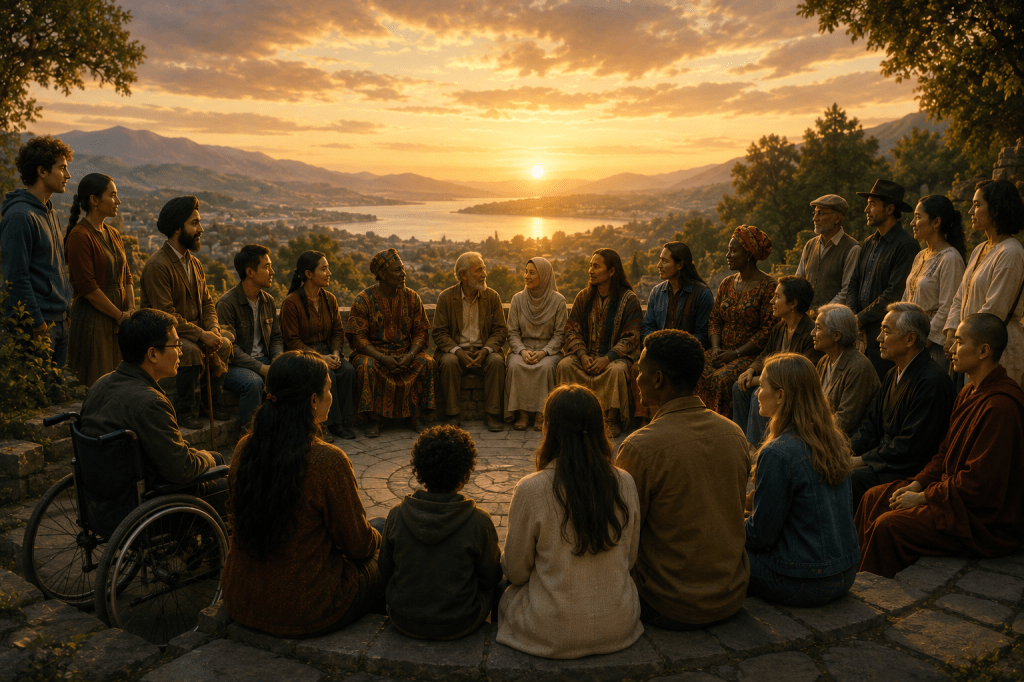
The truth of Being reveals something different. Every person is necessary and eternal. No race, culture, language, or people can possess a higher or lower dignity. Differences do not establish superiority or inferiority. They are distinct determinations within the one order of Being.
The child in a remote village and the elder in a crowded city belong equally to this order. The migrant crossing an ocean and the person who has never left their homeland possess the same inviolable dignity. None is closer to Being and none is further away.
Difference does not threaten unity. Diversity is not a defect to be corrected, nor a problem to be solved. It is one of the countless ways in which the richness of Being appears.
Living in the Light of the Eternal
When this truth begins to emerge, our encounters with others are transformed.
Prejudice gradually loses its foundation because there is no longer any basis for assigning a greater or lesser essence to those who stand before us.
Love of one’s heritage no longer requires comparison with other traditions. Cultural identity becomes a source of gratitude rather than competition.
Meeting another people or another culture no longer means confronting an opponent or a stranger. It becomes an encounter with another manifestation of the same eternal reality.
Unity no longer requires uniformity. Diversity no longer threatens unity. The many and the one cease to oppose one another.
Conclusion – Beyond the Weight of History
As long as the logic of becoming governs our understanding, every victory over prejudice remains fragile. One hierarchy disappears only for another to emerge in its place. History itself bears witness to this recurring pattern.
The recognition of the equality of Being points toward something deeper. It does not merely oppose one form of division with another. It calls into question the very belief that worth can be measured.
The truth glimpsed in our reflections on death and everyday life now reveals its ethical significance. No race, culture, or people stands above or below another, because all belong equally to the eternal order.
To encounter another in this light is no longer to meet a stranger defined by history, identity, or difference. It is to encounter another expression of the eternal. In that recognition, the divisions inherited from history lose their power to determine how we stand before one another.
 It Is What It Is
Leave a comment