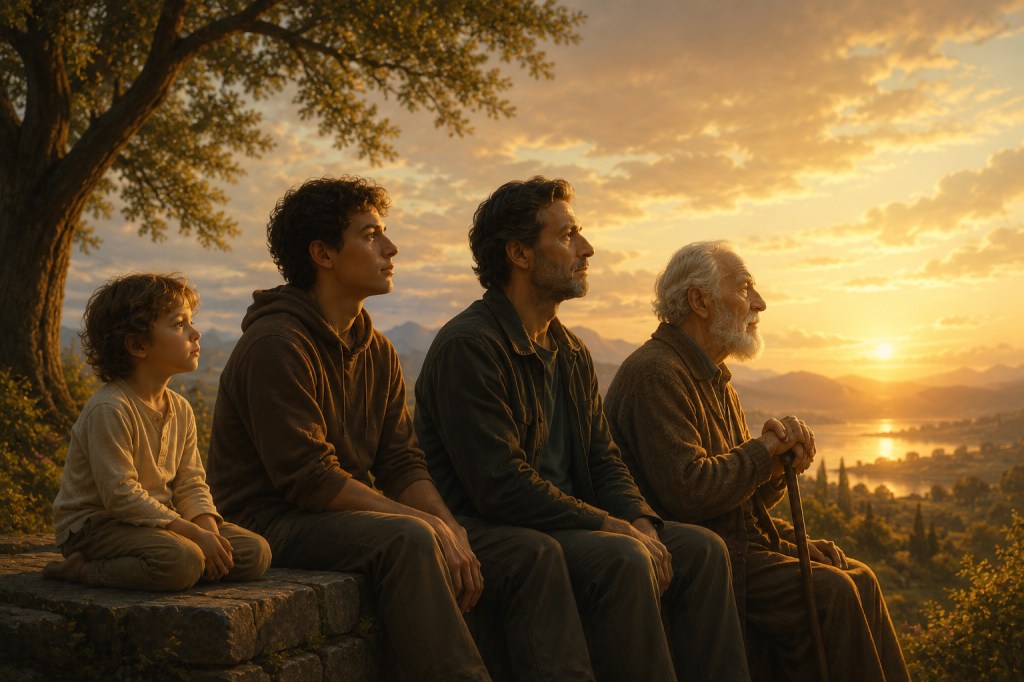
Age and the Illusion of Hierarchy
In our world, time is not merely a measure of duration. It becomes a scale of value. Age, like wealth or beauty, is arranged into a hierarchy. The child is regarded as incomplete and in need of formation. Youth is celebrated as vigor, promise, and possibility. Adulthood is valued for productivity and responsibility. Old age, though often respected, is quietly associated with decline and loss.
Even our attitudes reveal this tendency. The young may see the old as irrelevant, while the old dismiss the young as inexperienced. Each phase is measured against the others, as though life were a ladder and we were all either climbing or descending.
Yet this way of thinking belongs to the logic of becoming. When we begin to glimpse the truth of Being, something changes. The person is not becoming someone else. What changes is not the essence, but the way in which it appears. Seen in this light, every age reveals a necessary and irreplaceable aspect of the same destiny.
Time and the Fragmentation of the Self
Within the world of becoming, time fragments the person. The child is thought to be not yet who they will become. The adult is no longer who they once were. The elder appears as someone gradually fading into memory. Every moment seems provisional, either moving toward fulfillment or away from it. Identity is never fully present.
But if we begin from Being rather than becoming, this fragmentation begins to dissolve. The person is not a succession of selves replacing one another. What appears through the stages of life is the same eternal essence revealing itself under different lights. The phases of life are not isolated segments in a temporal chain, but distinct ways in which the unity of the person comes to appearance.
The child is not erased by adulthood, nor is youth abolished by old age. Nothing essential is left behind. What once appeared continues to belong to the eternal unity of the person, even when it no longer stands before us.
The Unity of the Person
The child is not a lesser human being. Their dignity does not wait upon maturity. Though many capacities remain hidden, the fullness of their destiny is already present. Wonder, dependence, and openness are not signs of incompleteness, but distinctive ways in which the eternal reveals itself.
Nor is the adult more truly a person than the child or the elder. Strength, responsibility, and productivity may become more evident, but they do not confer greater reality. Even in moments of greatest achievement, one is not more oneself than one was as a child or will be in old age.
The elder, far from being a diminished version of who they once were, reveals another light of the same destiny. Their youth has not disappeared. It remains within the unity of what they are, not merely as memory, but as an eternal dimension of their being. To recognize this is to begin to see beyond the tragic belief that we are slowly being erased.
The Distinct Gifts of Every Age
Every age reveals something unique.
The child carries the freshness of a world newly opened. Their openness and dependence remind us that none of us stands alone and that vulnerability itself belongs to the human condition.
Youth brings intensity, discovery, passion, and the first awakenings of identity and love. Even its uncertainties testify to the richness of a destiny still unfolding into appearance.
Adulthood reveals responsibility, creativity, and the capacity to sustain others. Through work, relationships, and commitment, it manifests forms of care and fidelity that are no less essential than the qualities of childhood or youth.
Old age discloses another depth. The slowing of the body often gives way to a different kind of presence, one marked by reflection, memory, and a quiet wisdom that no earlier stage can replace.
None of these ages is higher or lower than the others. Each reveals something irreplaceable. Together they belong to the unity of a person whose reality is never divided.
The Eternal Face of the Other
To see the child in the light of eternity is to meet them not with condescension, but with reverence. To see the elder in the same light is to meet them not with pity, but with gratitude and wonder. In every face, whether youthful or lined with age, something shines that does not pass away.
The body changes, yet the person cannot be reduced to the changing body. Even bodily appearance belongs to the order of Being. It is not merely matter in motion, but the visible manifestation of a destiny that cannot be separated from what it reveals.
To encounter another is therefore never to encounter a temporary phase on a journey toward nothingness. It is to encounter the eternal. Love no longer depends upon usefulness, attraction, or affinity. It begins with recognition. The other is not valuable because they satisfy our desires or serve our purposes. They are valuable because they are. They are necessary, and we stand neither above nor below them.
Conclusion – Eternity in the Present
This is not merely a reflection about what lies beyond death. The insight that nothing essential is lost and that every being belongs eternally to the order of Being casts its light upon the ordinary moments of daily life.
The truth of Being does not wait for death to reveal itself. It is already present in every encounter.
The child at play, the youth in turmoil, the adult burdened with responsibility, and the elder resting in silence are not separate realities. They are different lights of the same eternal person.
To live in this awareness is not to escape time, but to see its appearing in a new light. Every encounter becomes an encounter with the eternal, and every moment, even the most ordinary, becomes a revelation of what cannot pass away.


Leave a Reply