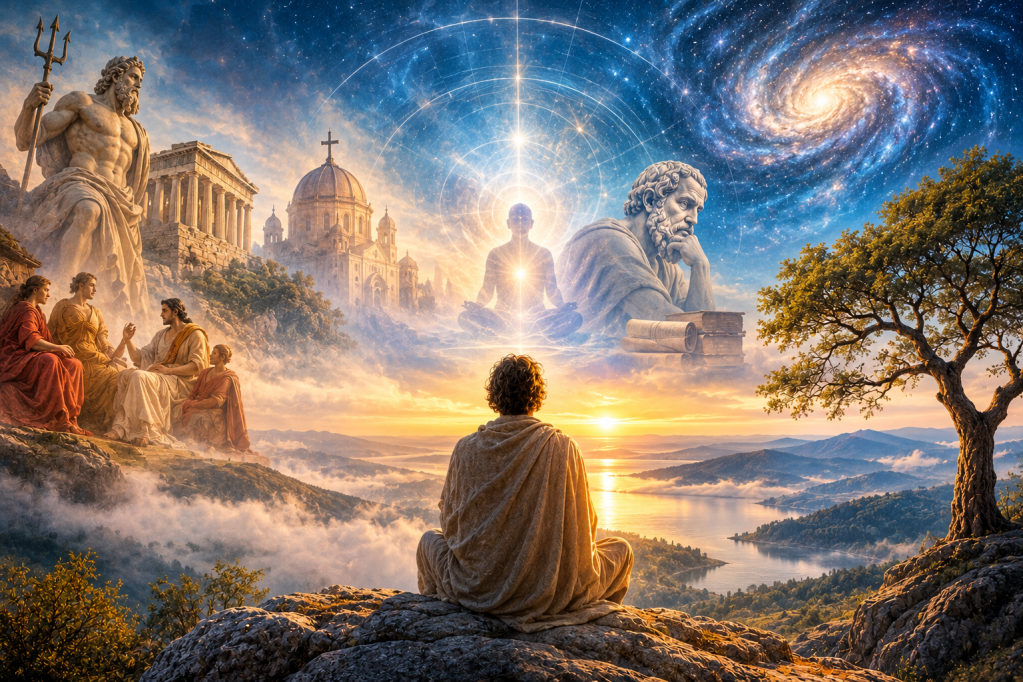
From Myth to Mysticism and the Unveiling of Being
Humanity has always sought to understand what holds everything together. We have told stories of origins, worshiped the divine, searched for union through mystical experience, and questioned the nature of reality through philosophy. These approaches differ, sometimes profoundly, yet they share a recurring question: how can we understand the relationship between ourselves and the whole of existence?
Perhaps what we have been seeking is not something distant or lost, but something that has never ceased to be what it is.
The Language of Myth
Long before philosophy, human beings told stories about the origins and destiny of the world. Myths spoke of gods, creation, death, and rebirth, of cycles in which nothing seemed entirely lost and everything belonged to a larger order.
Myth did not seek to establish its truths through argument. It expressed them through images, characters, and stories. Beneath these narratives we may recognize an intuition that has never disappeared: that what exists belongs to something greater than the succession of individual lives.
Myth could not yet articulate this intuition philosophically. It preserved it in the language available to it, like a memory whose meaning had not yet become clear.
The Voice of Religion
Religion gave this intuition a more explicit form. It spoke of the divine as the source and ground of existence, of a unity to which the human being belongs and with which the soul seeks communion.
Yet religious language often introduced a distance between humanity and its divine ground. Heaven and earth, Creator and creation, sin and redemption became the terms through which the relationship between the finite and the Infinite was understood.
Unity appeared as something that had been lost and must be regained. Human existence became a journey from separation toward reconciliation, from exile toward return.
From the perspective developed here, this separation is not simply an error to be dismissed. It is itself a necessary way in which the relationship between the finite and the eternal has appeared in human understanding. Even the longing for reconciliation bears witness to an underlying unity that it cannot entirely abandon.
The Glimpse of Mysticism
Mysticism brings the question closer to direct experience. Rather than speaking only of a relationship with the divine, it speaks of an immediate recognition of unity, of the discovery that the deepest truth of the self is inseparable from the One.
Thomas Merton expresses this intuition in words that have become widely known:
“We are already one. But we imagine that we are not. And what we have to recover is our original unity. What we have to be is what we are.”
Here we approach a threshold where religious language begins to open beyond its own boundaries. Unity is no longer merely something to believe in or hope for. It is something to recognize.
Yet mystical language often continues to speak of recovering, awakening, and returning, as though unity had once been lost. The experience points toward what is already present, while its interpretation may still describe it as the destination of a journey.
The question then becomes unavoidable: can what is eternal ever have been absent? Can Being itself be recovered, if it has never ceased to be?
The Search of Philosophy
Philosophy takes up this question in another way. It seeks to understand what myth expresses through images and what mysticism encounters through experience.
The Greek question of Being already contains this possibility. What does it mean for something to be? What is the relationship between what appears and the reality to which it belongs? Can what exists ever become nothing?
Yet philosophy has also developed ways of thinking that place becoming, possibility, and contingency at the foundation of reality. The world is understood as a process in which things emerge from what they were not and eventually disappear into what they no longer are.
From the perspective of the Structure of Being, this is where a fundamental contradiction emerges. If Being is, how can it become non-being? How can what exists ever be nothing?
The belief that Being can pass into nothingness is not merely one philosophical position among others. It is the deeper assumption that makes possible the conviction that things might either be or not be.
This is what Severino identifies as the fundamental error of Western thought: the belief that beings are contingent, that they can emerge from nothing and return to nothing.
The question is therefore not whether the world changes. Change plainly appears. The question is whether change requires the annihilation of what is and the production of what is not.
The Unveiling of What Cannot Not Be
Yet even the denial of Being presupposes Being. To imagine that everything might disappear is already to affirm the existence of what is imagining it.
In this sense, the history of myth, religion, mysticism, and philosophy can be understood as a succession of ways in which the question of Being has appeared to humanity.
They are not identical, nor do they necessarily express the same understanding. Their differences matter. But each, in its own way, brings us before the question of what it means for anything to be.
The recognition toward which this inquiry points is not the discovery of a hidden substance behind the world, nor the dissolution of all differences into an undifferentiated unity.
It is the recognition that every being belongs eternally to Being. What appears is not something that might just as well have been nothing. Its appearing is necessary, even when that necessity remains concealed from us.
There is therefore no return to the One, because there was never an absolute departure. What we call awakening is not the recovery of something lost, but the recognition of what has never ceased to be.
To see this is not simply to believe in unity. It is to begin to witness what unity means.
The Stillness Beyond the Quest
When the search reaches this threshold, myth, religion, mysticism, and philosophy do not simply disappear. Their questions, images, experiences, and distinctions remain part of the reality they sought to understand.
What changes is the direction of our inquiry. We no longer look for unity as something beyond the world, waiting to be attained. We begin to recognize that the world itself, in all its differences, belongs to the eternal.
The One we sought to name was never elsewhere. It is not a separate reality standing behind what appears. It is the eternal belonging of every being, in its irreducible difference, to Being.
We are not moving toward unity. Our lives, our questions, and even our search for awakening already belong to it.
And when this begins to appear, the quest takes on another meaning. We no longer seek to become what we are not. We begin to recognize what we have never ceased to be.


Leave a Reply