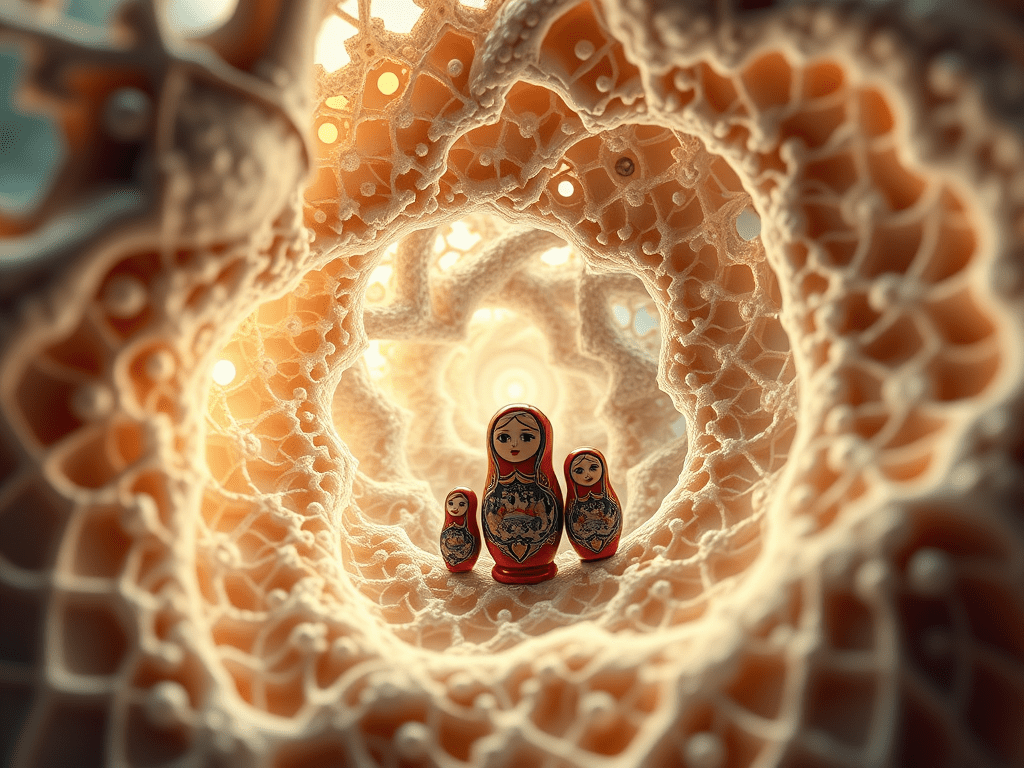
The One and the Many
At the core of reality lies a fundamental truth: Being is one and undivided, yet it consists of an infinite plurality of distinct entities. Each being is itself, maintaining its unique identity, and yet it is seamlessly one with all others. This paradox—that everything is irreducibly itself while being inseparably unified—challenges our everyday perception, which is conditioned by time and fragmentation.
Philosophers, mystics, and religious traditions have long glimpsed this unity, often struggling to express it within the limitations of language and human thought. Jesus’ prayer in the Gospel of John captures this profound mystery: “That they may all be one, just as you, Father, are in me and I in you, that they also may be in us” (John 17:21). Here, Christ does not call for uniformity, nor the dissolution of individuality, but the realization of an inseparable unity—a harmony where distinction does not entail division.
The Veil of Time and Fragmentation
In our ordinary experience, time imposes a sequential, fragmented view of reality. Events, people, and objects appear in succession, giving rise to the illusion of separation. This division, however, is an appearance—a perspective generated by the way things unfold within temporal experience. Outside of time’s constraints, Being is whole, unbroken, and eternally present.
Many who have undergone near-death experiences (NDEs) report a sudden dissolution of time, where past, present, and future are perceived simultaneously. They often describe an overwhelming sense of unity with all things while still recognizing themselves as distinct. Similar accounts emerge from mystical traditions and certain paranormal experiences, where boundaries between self and other dissolve, unveiling a greater whole that had always been present but obscured by the veil of temporal perception.
Philosophically, this paradox has been likened to fractals—patterns that repeat infinitely within themselves. Originally a concept from mathematics and physics, fractals describe self-replicating structures that retain the same pattern at every scale, no matter how zoomed in or out. Each part of a fractal is distinct and self-contained, yet it mirrors the whole, illustrating a fundamental structure where individuality and totality coexist. This idea was later adopted by philosophers to explain the relationship between the individual and the whole, offering a striking metaphor for understanding how unity can manifest within multiplicity. Others have also drawn analogies to Russian nesting dolls, where each figure is its own being, yet they all interlock into a singular, unified structure.
The Resolution in the Eternal Structure of Being
The fragmented experience of time does not negate the unity of Being; rather, it reveals the way unity manifests within temporal perception. To move beyond the illusion of division is not to dissolve individuality but to recognize its inseparable relation to the whole. The realization of this truth brings an end to the false dilemmas of isolation, existential separation, and nihilism.
Religious traditions, especially in their esoteric dimensions, point toward this ultimate reconciliation—where God is both transcendent and immanent, where the individual and the whole are not at odds but harmonized in eternal necessity. This understanding dissolves the contradictions imposed by temporal perception, allowing the eternal oneness of Being to appear as it truly is: undivided, infinite, and yet wholly manifest in each being, each moment, each existence.
Conclusion
What appears divided in time is already one in eternity. The realization of this truth is not a distant ideal but the inevitable unveiling of what has always been. Whether glimpsed in religious experience, philosophical reflection, or extraordinary states of consciousness, the oneness of Being continually makes itself known, even if veiled by the sequence of time. As each being recognizes itself within this eternal unity, the truth of Jesus’ words unfolds: “That they may all be one.”


Leave a comment