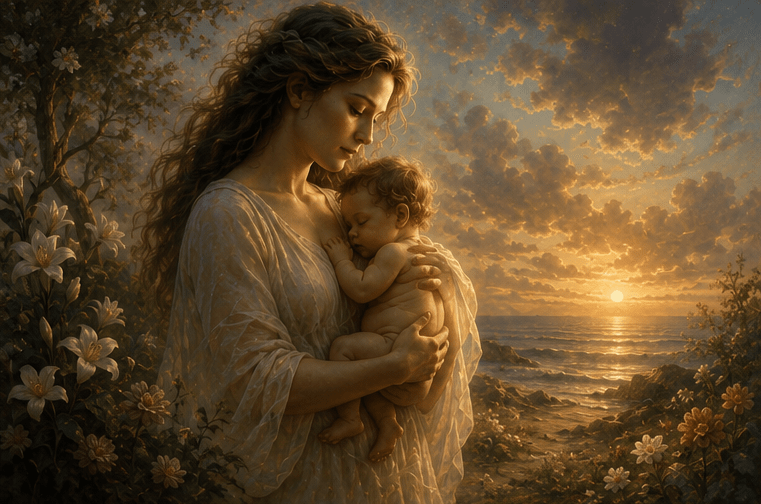
To speak of the feminine is to speak of one of the most immediate yet most obscured truths: that human life enters the world through woman. It is so simple that it risks being overlooked, so evident that no society has ever been able to dispense with it. Yet in the modern horizon this truth, once surrounded by forms of reverence, is increasingly subjected to forms of denial. To recover its meaning is not to return nostalgically to earlier orders, but to recognize how both their reverence and their distortions point toward something deeper that cannot be erased.
Memory of Reverence
In ancient myth and culture, the feminine was inseparable from fertility, earth, and continuity. Woman was not only mother to her children but also an image of nature’s capacity to give and sustain life. Even where reverence took the form of idealization or subordination, it still bore witness to a fundamental recognition: the feminine body was understood as more than mere flesh. It appeared as the threshold through which human life enters the world.
Women themselves have lived this reality not only as biological fact but as lived self-understanding. Generations were shaped in relation to maternity, whether embraced, resisted, or imposed. Female self-understanding carried expectations tied to fertility, care, and beauty as signs of life-giving capacity. These expectations were often restrictive, yet they also revealed how deeply human societies recognized something irreducible in the feminine.
Crisis of Denial
Modernity, through its technological and cultural transformations, has both expanded and destabilized this self-understanding. Contraception, abortion, in vitro fertilization, surrogacy, and the medicalization of childbirth have fractured the ancient unity between woman and the emergence of life. For the first time in history, the process of giving birth can be suspended, externalized, or technologically mediated. Childbirth becomes a clinical event, the womb can be leased, and the embryo manipulated within procedural frameworks.
At the same time, cultural narratives increasingly suggest that woman’s value is independent of maternity, and that motherhood is optional or secondary to self-realization. Female identity is thus exposed to fragmentation: some affirm maternity as empowerment, others experience it as limitation, while others feel compelled to suppress it in order to affirm equality. Ideologies that propose the erasure of sexual difference often generate, rather than resolve, a deeper instability, because what is conceptually denied persists in lived experience.
This tension is not only external but internal. Many women, moving between competing symbolic frameworks, experience a form of estrangement from their own embodied condition. What was once lived as necessity is now presented as pure choice, and choice, when detached from necessity, can generate paralysis as much as freedom.
The Indestructible Structure
Yet the fundamental structure of the feminine cannot be erased. Even when obscured, its traces remain visible: in the woman who brings life into the world through enduring bodily transformation, in the forms of care that sustain familial and social continuity, in the often unseen labor of attention and relational intelligence through which human life is maintained. These are not marginal phenomena but expressions of a structure that persists beneath shifting cultural forms.
Woman remains the one through whom human life enters appearance. Even when technology intervenes, even when ideology reframes meaning, even when self-understanding fluctuates, this structure does not disappear. It is not reducible to culture or convention. To be feminine is not exhausted by maternity, yet it cannot be severed from it without distortion of its meaning.
This does not imply a reduction of woman to reproductive function, nor a return to earlier forms of hierarchy or idealization. It indicates rather that the feminine, in its essence, exceeds the instability of cultural interpretation. Its truth belongs to the eternal structure of being, which no historical configuration can fully exhaust.
Toward the Horizon
The present crisis of the feminine, however disorienting, is not without necessity. It is part of the broader unfolding through which what is essential becomes more clearly visible. The denial of woman’s role does not abolish it; it reveals the depth of its persistence. Distortion itself becomes the site where indestructibility appears.
What emerges, then, is not the disappearance of the feminine but the possibility of its clearer manifestation: beyond idealization and rejection, beyond fragmentation and simplification. In this horizon, woman appears in her enduring identity not as a contingent cultural construct, but as a necessary dimension of human existence, within which life itself takes form.


Leave a comment