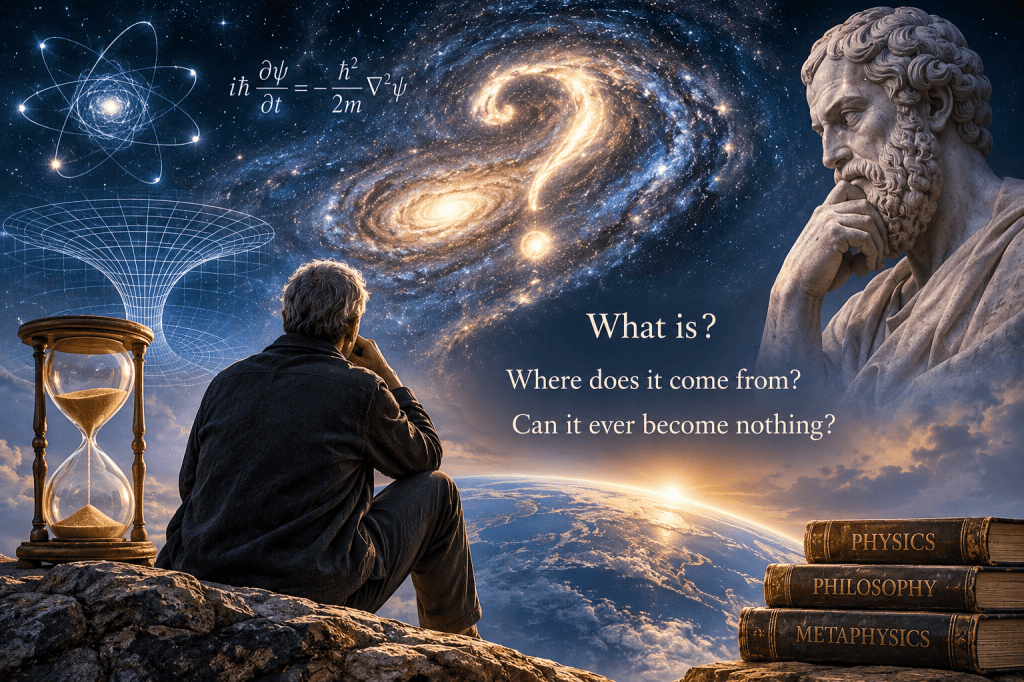
The Limits of Physical Description
Physics has become extraordinarily successful at describing the universe. It reveals the structures of matter, the relationships between energy and space, and the transformations through which the physical world unfolds. Its equations allow us to predict phenomena with remarkable precision. Yet the deeper our descriptions reach, the more clearly another question begins to emerge: what exactly are we describing?
A physical theory can tell us how one state relates to another, how a system changes, and what conditions make a particular event possible. It can describe the evolution of the universe and investigate the earliest stages accessible to our models. But describing a transformation is not necessarily the same as explaining what it means for something to be at all. The question of how things change and the question of why there is something rather than nothing are not identical.
This distinction becomes especially interesting when physics examines the foundations of time. Some approaches to quantum gravity, for example, do not include time in the familiar way as an external parameter governing the evolution of the universe. This does not mean that physicists have demonstrated that time is unreal, or that the universe is simply frozen. It does show that the time we experience may not be fundamental in the way we ordinarily assume. What we take to be the most basic framework of reality may itself require explanation.
The Question of the Observer
There is another difficulty. Physics describes a world that can be observed, measured, and represented mathematically. But the observer is not simply outside that world, looking in from somewhere beyond it. The observer and the instruments of measurement are themselves part of the physical reality being investigated. They do not provide a standpoint outside reality as a whole.
In quantum physics, the role of measurement raises particularly difficult questions. But we should be careful not to turn this into the claim that human consciousness creates the universe, or that reality depends on someone looking at it. In physics, an observer does not necessarily mean a conscious mind. It can refer to a measuring system or to the physical interaction through which a quantity becomes accessible.
Still, a more fundamental question remains. The world described by physics is also the world that appears. Measurement, observation, and description are themselves events within reality. We cannot simply place them outside the whole and assume that they provide a view from nowhere.
This does not invalidate scientific knowledge. It invites us to recognise its position. Physics describes the structures and relations through which reality becomes intelligible to us. But the question of what it means for anything to appear, and what it means for anything to be, reaches beyond the equations themselves.
From Becoming to Being
Here we approach the boundary between physics and metaphysics. It is not a boundary where science fails and philosophy takes over, nor does it mean that philosophy possesses answers that science has yet to discover. The two inquiries ask different kinds of questions. Physics investigates the measurable structures and transformations of the universe. Metaphysics asks what must be true for anything to be at all.
One of the deepest assumptions in our ordinary understanding of reality is that things come into existence and eventually cease to exist. We see birth and death, formation and dissolution, the emergence of stars and the disappearance of entire worlds. It seems natural to conclude that what exists can pass into nothing, just as what does not exist can come into being.
But there is a difference between observing transformation and establishing that something comes from nothing or returns to nothing. Physics describes one state giving way to another, matter changing form, structures dissolving and new structures appearing. Even the physical vacuum is not absolute nothingness. It has a structure and properties that can be investigated. The language of beginnings and endings therefore does not, by itself, establish a passage between Being and nothing.
This brings us to a question that no equation can settle on its own: can what is ever become what is not? If something truly became nothing, it would not simply have changed form or ceased to appear in a particular way. It would amount to the passage of Being into what is not. And if something came from absolute nothing, we would have to explain how nothing could give rise to something.
The question is not whether the physical world changes. It plainly does. The question is whether change requires us to think that Being itself is subject to becoming, or whether becoming concerns the ways in which what is appears.
Perhaps this is where physics and metaphysics can illuminate one another without becoming the same inquiry. Physics continues to reveal the extraordinary depth and complexity of the universe. Metaphysical reflection asks us not to mistake the changing forms of its appearance for the coming and going of Being itself.
The issue is therefore not simply whether science will eventually discover a final equation that explains everything. It is also what we mean when we speak of origins. Across several sciences, we investigate the origin of the universe, the emergence of matter and life, the development of consciousness, and the formation of the structures that make the world intelligible. Each inquiry traces particular conditions and processes through which something becomes possible. Yet the question remains: what made the existence of those conditions possible in the first place?
There is a point at which the search for an earlier state no longer answers the question we are asking. We may describe the earliest stages of the universe accessible to our theories, investigate what preceded a particular physical event, or explain how one form of organisation emerged from another. But an earlier state is still something that is. We have traced the appearance of one configuration to another, not necessarily explained the origin of Being itself.
This is where the question of origin meets the question of becoming. If we assume that things come from nothing and eventually return to nothing, we are treating Being as something that can begin and cease to be. But is that what our explanations actually establish? Or do they describe the changing ways in which what is appears?
Perhaps the most fundamental question is therefore not only how the universe began, or how life and consciousness emerged within it, but whether Being itself can have an origin at all. Can what is come from what is not? Can it ever become what it is not? Or does every account of origins already presuppose the very Being whose origin it seeks to explain?


Leave a Reply