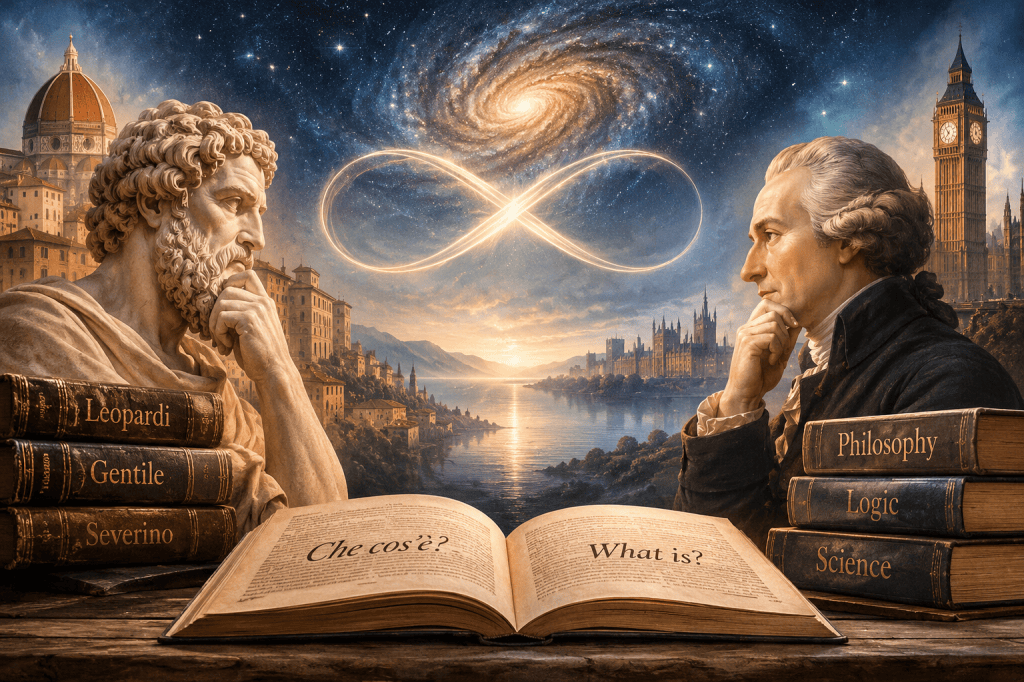
I’ve noticed something curious. When I write about the eternal structure of Being, Italian readers sometimes seem to grasp the ideas more readily, almost instinctively. The same ideas, expressed in English, can meet greater hesitation, or be received as abstract metaphysics belonging to a distant philosophical past. This is only an impression, of course, and there are many exceptions. Yet it raises an interesting question: might different intellectual traditions shape not only how we speak about Being, but also how readily we recognise the questions it raises?
In the Italian and broader Continental traditions, philosophy has maintained a particularly persistent dialogue with the question of Being. Even when it turned toward tragedy, finitude, or nihilism, the ultimate question was rarely absent: what is? Leopardi, Gentile, and Severino, each in a very different way, confronted the tension between the finite and the eternal, between the threat of nothingness and the possibility that Being cannot be lost. Even despair could become a metaphysical question. The language of philosophy remained, in important respects, close to the question of Being itself.
In much of the English-speaking philosophical world, a different emphasis gradually became prominent. Questions of knowledge, language, logic, and the methods by which we understand the world came to occupy a central place. This did not mean that the question of Being disappeared. It was often approached through analysis, empiricism, and the examination of what can meaningfully be said or established. The emphasis shifted, and with it the vocabulary through which fundamental questions were explored.
Yet the search for what is fundamental has never belonged to one philosophical tradition. Today, some of its most striking expressions can be found in physics. When physicists investigate whether time is fundamental, or whether the universe can be described at its deepest level without an external time parameter, they reopen questions that philosophy has considered in other terms. The language is different, and the questions are not identical. But the possibility that time does not have the ultimate status we ordinarily attribute to it creates an unexpected meeting point between scientific inquiry and metaphysical reflection.
This may help explain why certain ideas can sound familiar in one intellectual setting and unfamiliar in another. The Italian and Continental traditions have often preserved a vocabulary in which Being, eternity, and the absolute can be discussed directly. In other contexts, related questions may emerge more naturally through the structure of matter, the foundations of physical theory, or the limits of scientific description. Neither approach has a monopoly on the question, and neither can simply replace the other.
The difference may have less to do with the languages themselves than with the histories of thought carried within them. Where philosophy remained closely engaged with poetry, religion, and metaphysics, the eternal continued to have an established vocabulary. Where other forms of inquiry became more prominent, the same fundamental concerns often found different ways of expressing themselves. They were not necessarily lost. They were approached from another direction.
This does not mean that physics is confirming what philosophy has already discovered, or that different traditions are arriving at an identical conclusion. Their methods and objects of inquiry remain distinct. But their questions can illuminate one another. The investigation of time in physics may invite us to reconsider assumptions that philosophical reflection has challenged for centuries. And philosophy may help us recognise the deeper implications, as well as the limits, of what scientific inquiry reveals.
Perhaps, then, we are witnessing not the triumph of one language over another, but the gradual opening of a shared horizon. Different traditions have preserved different ways of approaching what is fundamental. Their vocabularies may differ, their methods may diverge, and their conclusions may not coincide. Yet the question remains: is Being something that appears and disappears within time, or is time itself a dimension of the appearing of what eternally is?
That question cannot be settled by a change of vocabulary, nor by an equation alone. But it can become visible wherever thought is willing to look beyond its familiar assumptions. And perhaps this is where the two languages of eternity begin to meet.


Leave a Reply