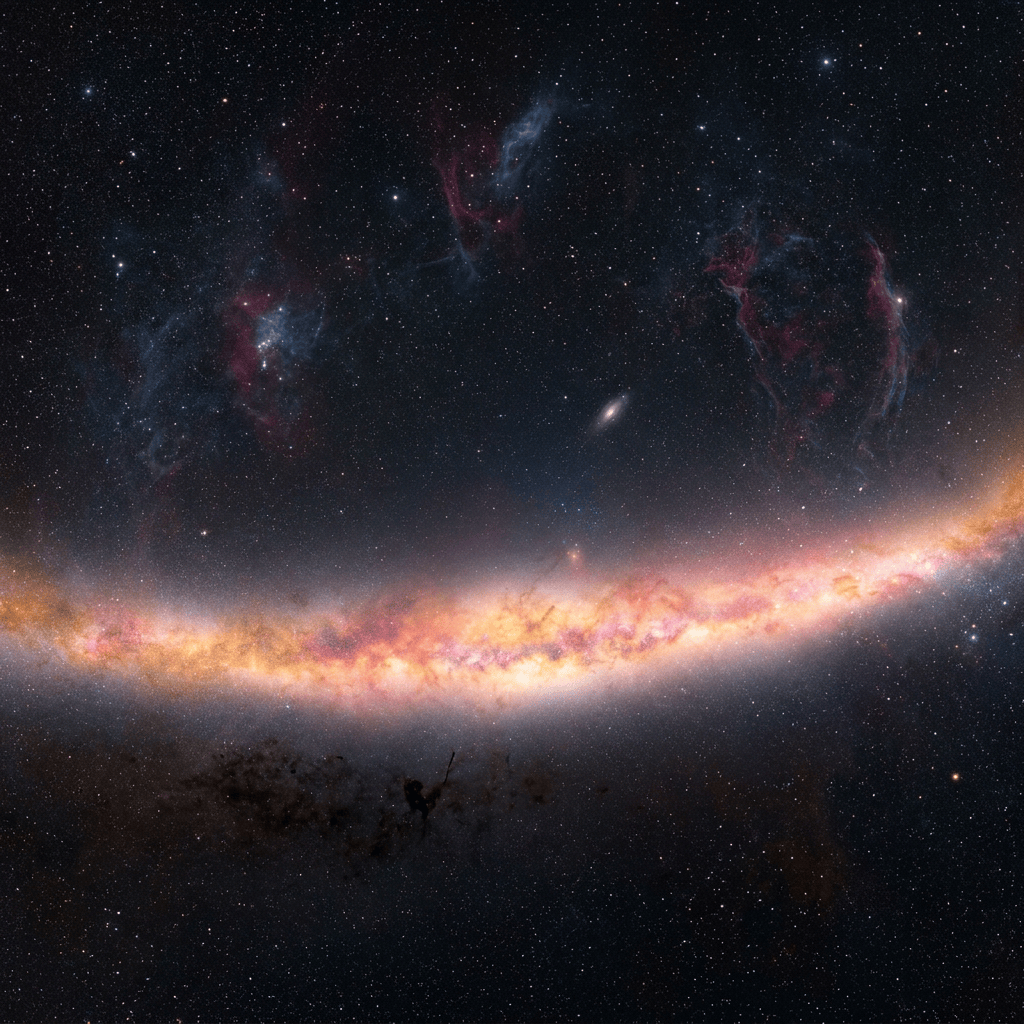
We tend to speak of reality as though everything must have a beginning. The universe began. Life began. Each of us began. And behind these statements there seems to be an obvious picture: before something existed, there was nothing, and then, somehow, that something appeared.
Three very different accounts of reality are often brought into this discussion: creation ex nihilo, Intelligent Design, and the scientific account of the universe and life through the Big Bang and evolution. They disagree profoundly about how things happen. Yet when these accounts are interpreted metaphysically, they can all be drawn into the same underlying picture: that what is can somehow arise from what is not.
But can it?
The Beginning We Take for Granted
From the standpoint of the structure of Being, following Parmenides and Emanuele Severino, the difficulty is not primarily scientific or theological. It is logical.
Nothing is not a very small thing. It is not an invisible substance waiting to produce something. Nothing is simply the absence of Being. It therefore cannot act, cause, produce, or transform itself into something else.
To say that something comes from nothing is consequently not to describe an extraordinary event. It is to attribute causal power to what, by definition, has no power whatsoever.
The same difficulty appears at the other end of existence. If a being ceases to be, where does it go? It cannot become nothing, because nothing is not a place or a state into which something can pass. A being cannot be both itself and not itself.
This does not mean that nothing ever begins or ends in our experience. Things clearly appear and withdraw. A person is born and dies. A star appears and disappears. Forms of life arise within the history of the earth and disappear from it.
But here we encounter a distinction that is easily overlooked:
The beginning of an appearance is not necessarily the beginning of Being.
What Science Actually Tells Us
This distinction is especially important when we speak about the Big Bang.
Cosmology gives us extraordinarily powerful descriptions of the early universe. It allows us to trace the development of cosmic structures back toward an extremely dense and hot state. But the existence of a boundary in our present physical models does not amount to an observation of absolute nothingness.
Physics describes what appears within the domain accessible to physical investigation. It does not observe “nothing producing something.”
The same is true of evolution.
Evolution describes the order and relationships through which living forms appear across time. Fossils, genetics, comparative anatomy and other evidence reveal an extraordinary continuity within the history of life. But none of this establishes that Being itself was produced from non-being.
Evolution can therefore be accepted completely as a description of appearances without turning it into an ontology of creation.
The scientific question is: How do the appearances of life and the universe relate to one another?
The metaphysical question is different: Can Being itself ever begin or cease to be?
Confusing these questions creates a problem that neither science nor theology can solve, because the problem has been formulated at the wrong level.
The Designer Does Not Solve the Problem
Something similar happens with Intelligent Design.
Suppose, for the sake of argument, that a structure displays intelligence, order, or purposiveness. That still does not explain how Being could come from nothing. Introducing an intelligent cause does not remove the fundamental difficulty. It merely gives the supposed production a more sophisticated producer.
The deeper possibility is different.
Perhaps order does not have to be injected into reality from outside. Perhaps what appears as order in time expresses an intelligibility that is not itself produced by time.
This does not diminish intelligence. It places it within a different understanding of reality.
The same question then returns to theology.
Can God Create from Nothing?
The traditional language of creation says that God created the world ex nihilo. But what exactly does “from nothing” mean?
If God is understood as infinite Being, then nothing cannot be regarded as some kind of material out of which God produces the world. Nor can omnipotence mean the ability to make contradictions true. God cannot make a square circle, not because divine power is insufficient, but because the phrase itself does not describe a possible reality.
The difficulty with creatio ex nihilo therefore lies deeper than the question of divine power. It lies in the assumption that there was once a nothing from which Being had to emerge.
Perhaps the language of creation can be understood otherwise.
“Let there be” need not mean “let something come into existence where previously there was nothing.” It may be heard as “let this appear.”
Creation then becomes manifestation rather than fabrication. It does not describe the production of Being, but the appearing of what is.
Such a reading does not necessarily diminish divine sovereignty. It may instead make divine infinity more coherent. God would not stand opposite a domain of beings that exist independently for a while before eventually falling back into nothingness. The relation between God and beings would no longer be conceived as a rivalry between two kinds of existence.
Creation would be the unveiling of Being, not its manufacture.
When the Beginning Disappears
This brings us back to eternity.
Eternity is easily misunderstood as an infinitely long duration, as though beings simply existed for an endless amount of time. But that is not what is at stake.
To say that beings are eternal is to say that they cannot become nothing.
Their appearances have beginnings and endings. Their configurations change. Their relations unfold within time. But Being itself does not enter into existence and then depart from it.
Time, on this view, is not a furnace in which beings are continuously produced and destroyed. It is the horizon within which beings appear in their ordered relations.
There is even an illuminating analogy here with modern physics. In the block-universe interpretation associated with relativity, past, present and future can be understood as different locations within spacetime rather than as three different degrees of reality. Physics does not prove the ontology of eternity, but this picture can help loosen our habitual assumption that only the present is real, while the past has fallen into nothing and the future has not yet emerged from it.
The past is not simply “what no longer exists.” It is what appears as having appeared.
The future is not simply “what does not yet exist.” It is what appears as yet to appear.
And the present is not a tiny point where Being is continuously created and destroyed.
Perhaps, then, the question “When did it all begin?” contains an assumption that should itself be examined.
Something can begin to appear without beginning to be.
Something can cease to appear without ceasing to be.
And if that is so, then the deepest structure of reality is not a movement between nothingness and Being, but the eternal Being of what is.
The universe does not need to have escaped from nothing.
Perhaps there was never a nothing from which Being had to escape.


Leave a comment