On the Hubris of Thought and the Appearing of Truth
Philosophy was born from wonder. Faced with the existence of things, the movement of the heavens, and the mystery of life and death, human beings began to ask questions that had no obvious answers. What does it mean for something to be? What is the relationship between ourselves and the world? What is true?
Yet wonder can take another direction. The desire to understand can gradually become the desire to possess what is understood. Thought develops its instruments, refines its methods, and builds systems. It begins to trust its own power to reach what it seeks.
The question is whether, in this movement, philosophy risks losing sight of what made it possible in the first place.
The Will to Know
The desire to know is not necessarily a desire for power. Curiosity, wonder, and the love of truth need not seek mastery. Yet the search for truth can become entangled with the conviction that truth is something not yet possessed, something that must be reached through the power of thought.
Here a deeper assumption enters. If truth is something we must produce or acquire, then it appears as something not yet present. Being seems to wait beyond the horizon of understanding, as though reality itself were incomplete until thought could grasp it.
This is the point at which the search for truth risks becoming a form of nihilism. It begins to treat Being as something that can be absent, and thought as the power through which that absence will be overcome.
Yet thought itself already belongs to Being. Before the philosopher begins to inquire, before a question is formulated or an argument constructed, Being is already appearing.
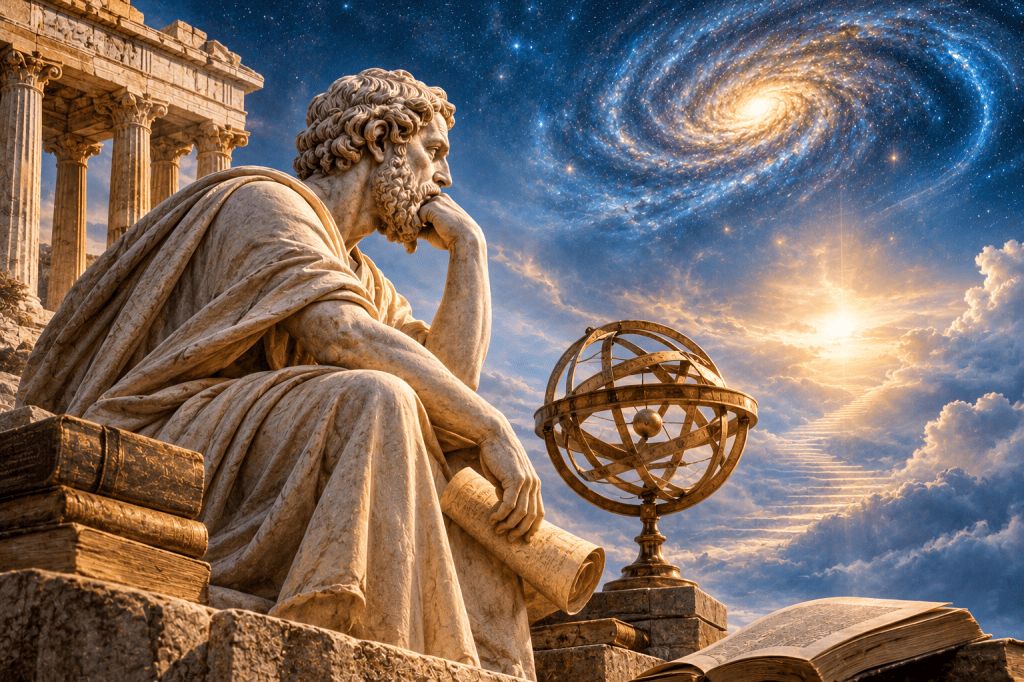
The philosopher resembles a craftsman who carves a statue of the sun and mistakes its glow for daylight. The statue may be beautiful, and the work may be exact. But the light it seeks to represent was never produced by the craftsmanship.
Philosophy as TechniquePhilosophy as Technique
There is nothing wrong with philosophical methods. Logic, language, analysis, and argument are indispensable to the clarification of thought. The problem arises when the method is mistaken for the source of truth.
At that point, philosophy begins to resemble technique in its deeper sense: the belief that reality can be brought under control through the refinement of our instruments.
The philosopher measures, defines, distinguishes, and corrects. Schools develop, systems emerge, and intellectual traditions establish their own standards of rigor. The work becomes increasingly sophisticated.
Yet a question remains. Does the refinement of our instruments bring us closer to Being itself, or does it merely make our representations of Being more elaborate?
A method can clarify what we think. It cannot produce the Being that makes thought possible.
When philosophy forgets this distinction, it risks turning truth into an intellectual achievement. The philosopher begins to stand before reality as though it were an object waiting to be mastered, something separate from the thought that seeks to understand it.
The more thought tries to grasp Being as an object, the more it risks overlooking the fact that it already belongs to what it seeks.
The Tragic Paradox
And yet, even this attempt at mastery is not outside Being.
The desire to possess truth, the construction of philosophical systems, and the conviction that thought can establish reality are themselves ways in which Being appears in the history of human understanding.
This is the paradox. Philosophy can misunderstand its own relationship to truth, but it cannot escape the reality that makes its misunderstanding possible.
Its hubris is not an accidental interruption of Being. It belongs to the necessary appearing of thought, including the possibility that thought may eventually recognize the limits of its own claims.
The recognition of those limits does not require philosophy to abandon reason. It requires reason to examine the assumptions through which it understands itself.
The collapse of philosophy’s claim to produce truth need not be the end of philosophy. It may instead mark the beginning of a different relationship to what it seeks.
Thought no longer assumes that Being is waiting to be brought into existence through understanding. It begins to recognize that its own activity is already an appearing of Being.
The Turning of Thought
The task of philosophy, then, is not to conquer Being but to examine what it means for Being to appear.
This does not mean abandoning the work of thinking. It means reconsidering its purpose. Philosophy need not create truth, but it can clarify the assumptions that conceal what truth means.
Even the will to power, the arrogance of intellect, and the endless construction of systems belong to the Whole. Nothing stands outside the necessity of Being, not even the thought that imagines itself capable of standing apart.
The pride of thought is therefore not something to be condemned from a position of superior wisdom. It is something to be understood.
And when its underlying assumption becomes visible, the will to possess truth can give way to another possibility: the recognition that truth was never an object waiting to be acquired.
Philosophy no longer stands apart from Being, trying to reach it. The philosopher, the act of thinking, and what is thought all belong to the same appearing.
Not the individual mind creating Being, but Being appearing as thought.
The Stillness Beyond Knowing
When philosophy becomes silent, it does not fall into ignorance. Nor does it abandon the distinctions through which thought becomes clear.
It rests in the recognition that no method can produce the Being that every method already presupposes.
Thought no longer needs to establish itself as the absolute origin of truth. It can become attentive to what is, without imagining that reality depends upon its power to grasp it.
What remains is not the mastery of reason, but the recognition of its place within Being.
Nothing is missing from Being. Nothing waits beyond it to complete what it is.
Philosophy began in wonder. Perhaps its deepest fulfillment is not the conquest of what it wondered at, but the recognition that the mystery was never separate from the one who wondered.
Being has never been absent.
It is what appears, even as thought.


Leave a Reply