We are familiar with the ancient divisions: flesh and spirit, body and soul, time and eternity. For millennia, religions and philosophies have described human existence through these apparent oppositions. We have imagined ourselves caught between two worlds, belonging to one while longing for the other.
But what if this division rests upon a fundamental misunderstanding? What if the conflict is not between two opposing realms, but between the eternal necessity of all that is and the finite, successive way in which beings appear?
What if the world we experience as fragmented has never been separated from the Whole to which it belongs?
The Figurative Explanation: The Eternal Tapestry
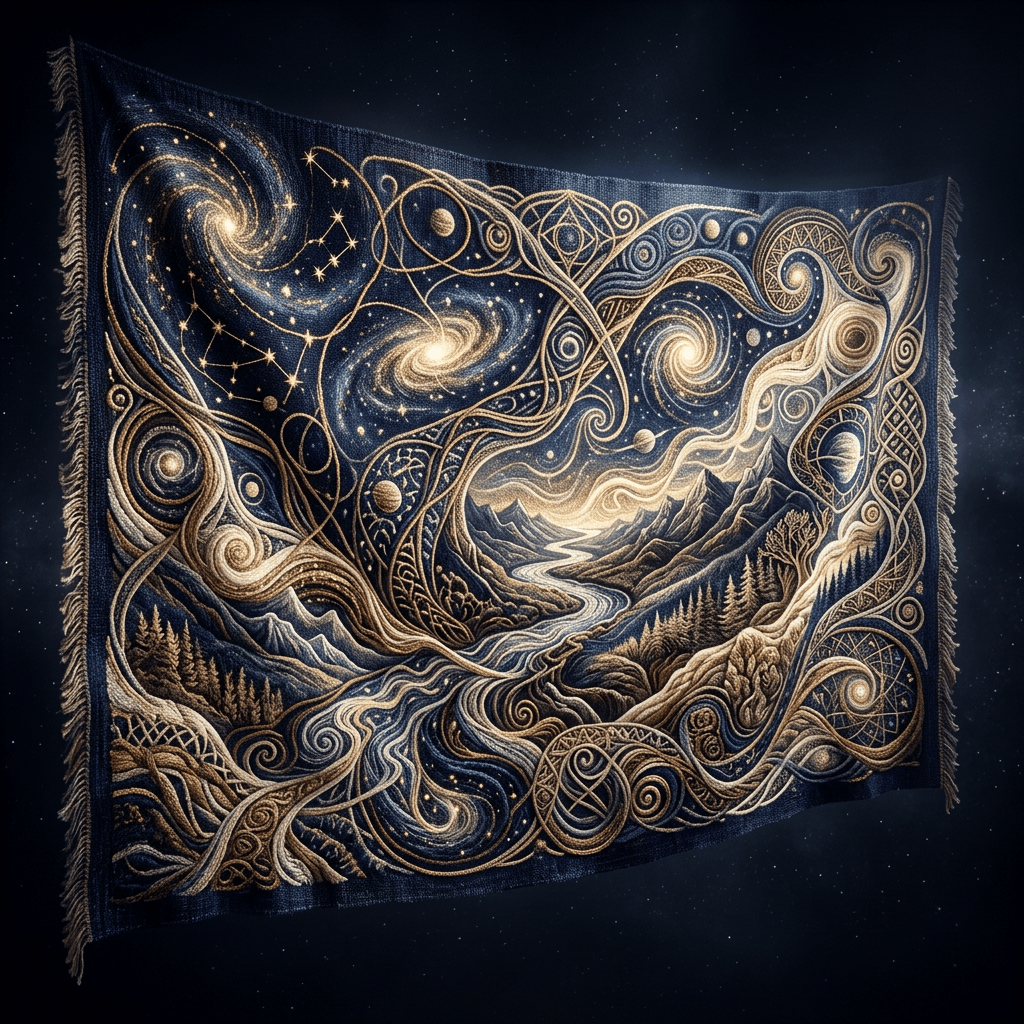
Imagine reality as a magnificent tapestry, containing every being, every event, every thought, every moment of what we call past, present, and future.
The tapestry is not being woven into existence. It is complete. Nothing can be added to it, and nothing can be removed. Every thread, every color, every intricate relationship belongs eternally to its pattern.
This is the Totality, what Severino calls the Eternal. Not an immense object standing behind the world, but the entirety of what is, in the necessity of its being.
Now imagine that we can perceive this tapestry only through a narrow opening, through which its threads appear in a particular order. A blue thread appears, then a red one, then a golden one. We experience a succession of colors, each appearing and then giving way to another.
From within this succession, it seems that what appears now is all there is. What has appeared seems to have disappeared, and what has not yet appeared seems not to exist.
This is the experience of the finite. It is the world of time, of birth and death, of coming and going.
But the succession of appearances does not mean that the threads themselves are being created and destroyed. Each belongs eternally to the tapestry, even when it does not appear within our present view.
The apparent division between the eternal and the temporal arises when we mistake the order in which things appear for the totality of their being.
The Philosophical and Theological Core
The contradiction begins when we, as finite beings, interpret the succession of appearances as the coming into existence and disappearance of Being itself.
We experience birth and death, creation and destruction. These are not imaginary experiences. But we often understand them as though what appears were produced from nothing and what disappears were destined to return to nothing.
This assumption shapes much of our language about reality.
The Language of Becoming
We speak of things that begin to exist, develop, and eventually cease to be. We imagine that what exists might just as well never have existed, and that what does not exist might one day emerge into being.
When this understanding is applied to the divine, we often imagine a God who creates a world that was not, sustains it through time, and ultimately brings it to its final destiny.
But if Being is eternal, then creation cannot mean the production of beings from absolute nothingness. Nor can destruction mean their absolute annihilation.
The question is not whether the world appears to change. It plainly does. The question is whether this change requires Being itself to become what it previously was not.
The Limits of Our Systems of Thought
Every religion and philosophy seeks to understand reality from within the horizon of its own appearing.
Myth speaks through images and stories. Religion speaks through creation, divine presence, and salvation. Mysticism speaks of union and awakening. Philosophy seeks to clarify these intuitions through thought.
Their differences are real and important. Yet each encounters the same fundamental question: how can we understand the relationship between the finite beings that appear and the eternal Being to which they belong?
The danger arises when a particular way of understanding this relationship is mistaken for the totality of reality itself.
The eternal is then reduced to an image, a doctrine, or a destination. What was intended to reveal the Whole becomes another way of separating it from the world.
The Problem of Evil
The problem of suffering brings this difficulty into its sharpest focus.
From within our finite experience, suffering and injustice can appear as absolute horrors. We ask how such things can exist in a world supposedly grounded in goodness, love, or divine necessity.
The tapestry metaphor may help us reconsider the question, but it must not be used to dismiss suffering or justify it by appealing to a greater purpose.
The pain is real in its appearing. Its necessity does not make it less painful, nor does its belonging to Being turn injustice into something morally acceptable.
The deeper question is whether suffering can be understood as evidence that Being itself is fractured, incomplete, or ultimately defeated.
To recognize the eternal necessity of beings is not to claim that every suffering has a purpose we can understand. It is to question whether suffering, however real, can signify the absolute annihilation of what is.
The Dawn of a New Understanding
What, then, is the possibility of a different understanding for those who experience life through this successive appearing?
The movement is not from the flesh to the spirit, from the material to the divine, or from the temporal world toward an eternal realm somewhere beyond it.
It is from the assumption that Being becomes and disappears to the recognition that what is cannot not be.
The finite is not a fragment of Being that has somehow become separated from the Whole. It is a determinate being whose appearing is finite, while its being is eternal.
This changes the meaning of our relationship to ourselves.
We are not merely temporary configurations destined to vanish. Nor are we eternal souls who must escape the material world to recover our true identity.
We are the beings we are, in all our irreducible differences, eternally belonging to Being.
The tapestry is not complete because it has absorbed its threads into an undifferentiated unity. It is complete precisely in the eternal necessity of every thread, every color, every relation.
The feeling of separation belongs to our finite experience. But separation in appearing does not mean separation in Being.
The Stillness of the Eternal
Perhaps this is where the ancient opposition begins to dissolve.
The eternal is not elsewhere. It is not a distant realm waiting to receive us when time comes to an end. Nor is the temporal world a lesser reality from which we must be liberated.
Every finite being belongs eternally to the Whole, without losing its own determinate identity.
We are not moving toward the Eternal as though it were something we have yet to attain. The Eternal is already the necessity of what we are, even when that necessity remains concealed within our experience of time.
The peace that passes all understanding does not arise from the promise that suffering will eventually be compensated, or that our lives will finally become something other than what they are.
It begins with the recognition that nothing real can be lost from Being.
The tapestry was never broken. Its threads were never separated from the Whole. What appears as a fragment has never ceased to belong to the Eternal.
And what is, cannot not be.


Leave a Reply