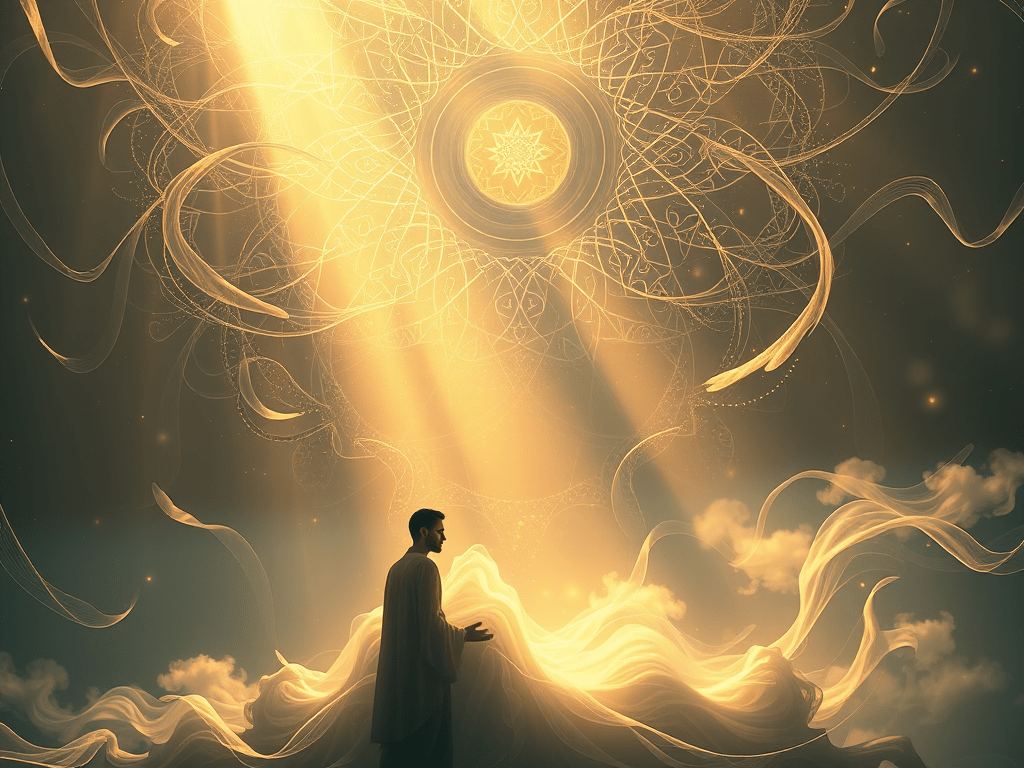
Islam begins not with speculation, but with submission. The central act of faith is not the search for self-fulfillment, nor a quest for union in the mystical sense, but the recognition of the utter transcendence of Allah, and the call to surrender before what infinitely exceeds human comprehension. The very word Islam means “submission”—not as a resignation to arbitrary power, but as a posture of openness before the Absolute.
And here lies its deepest intuition: that the human being is not self-grounding, and that truth is not a construction of the finite will. In this, Islam already points beyond the modern confusion between freedom and self-assertion. It recognizes that truth precedes us, commands us, and is not subject to our desires or interpretations. This is not merely a moral position; it is a metaphysical stance: truth is, and we are not its origin.
Yet here too, as in all traditions, the eternal is both intuited and misunderstood. For while Islam affirms that God is not part of creation, and that nothing is like Him, it also often reintroduces becoming where it seeks to speak of what is beyond time. Paradise is promised as a reward after death; the Qiyāmah (the Day of Resurrection) is expected as an event yet to come; divine judgment is depicted as a future act; and eternal life is framed as something attained through obedience, through acts, through merit.
But what is eternal cannot come to be. What truly is, cannot be the result of a process. If paradise is eternal, it cannot appear at the end of time. If divine justice is real, it cannot depend on a final day. And if God is truly beyond all becoming, then His will, His mercy, His presence, cannot unfold in time like human intention.
What Islam gets right, profoundly right, is the intuition that the self is not the origin of truth. That to live in truth is not to manipulate the world but to receive what already is. That the human being, in his essence, belongs to something greater, more permanent, and beyond all possession.
But what it has yet to fully recognize is that the necessity to which it submits is not the arbitrary decree of a transcendent will, but the eternal structure of Being itself; a structure in which every being is already grounded, every moment already held, every appearance already woven into the fullness of what is.
True submission is not fear before a distant power. It is joy before the necessity that makes fear impossible. It is the recognition that nothing can fall outside of Being. It is to cease striving to secure oneself, because nothing real can be lost.
This is the threshold on which the Islamic tradition now stands: not to abandon its essence, but to see that the truth it sought to obey has never been elsewhere, never delayed, never in need of reward or punishment to be itself. The eternal is not waiting. It is.
Symbols of Islam: Unity, Prophecy, Judgment, and Paradise
Every religious tradition speaks in symbols: images, narratives, and rituals that attempt to render the ineffable accessible. Islam is no exception. But what makes its symbolism distinctive is its rigorous insistence on divine unity, on the impossibility of mediation, and on the moral seriousness of history. These symbols contain both veils and glimpses of what cannot be said in the language of time.
Tawḥīd – The Unity of God
At the heart of Islam is tawḥīd, the uncompromising declaration that “there is no god but God.” It is a refusal to divide the divine, to anthropomorphize, to fragment Being into parts or powers. This is not merely monotheism. It is a metaphysical intuition: that what is real must be one, indivisible, and necessary.
And yet, this insight is often redirected into the logic of command and submission. Instead of seeing unity as the unbreakable coherence of all that is, it is often interpreted as the singularity of a will that governs from without. Unity becomes domination rather than necessity, a divine Person whose decrees must be obeyed rather than the eternal structure of Being in which no contradiction can stand.
Still, tawḥīd remains one of the most profound glimpses of the eternal in religious thought: the recognition that there is no real multiplicity outside of Being, and that nothing stands apart from what is. What appears to separate life and death, good and evil, self and world, must ultimately be shown to belong to a unity that no difference can destroy.
Prophecy – The Appearance of Truth in Time
The Qur’ān is said to be the uncreated word of God; eternal, perfect, descending into history through the mouth of the Prophet. In this, Islam affirms that truth is not fabricated, but revealed. The Prophet does not invent; he receives. He does not legislate from himself, but transmits what is given.
And yet, here too, the symbol conceals a contradiction. For if the word is truly eternal, it cannot descend. What is outside of time cannot enter time as if it were absent before. To speak of the eternal as “coming” is already to misname it. Prophecy, in its deepest sense, cannot be an event in time, but the necessary appearing of truth within the structure of Being.
Still, the figure of the Prophet points to something real: that truth is not the product of interpretation, that it is not contingent on consensus or historical development. Truth appears. And when it appears, it overturns the world; not by force, but by its own necessity.
Final Judgment – Justice and the Unfolding of Destiny
Islam speaks often of the Yawm ad-Dīn, the Day of Judgment, when each soul will be confronted with its deeds, weighed in the balance of divine justice. This image is central to Islamic moral thought: it gives meaning to responsibility, gravity to action, and coherence to history.
But judgment conceived as a future event preserves the illusion of delay. It places justice in a time yet to come, as if it were not already written in the structure of Being. In truth, if justice is real, it cannot depend on the outcome of time. What is just is eternally just. The structure of Being cannot permit contradiction to be ultimate. No evil remains unresolved, not because a future God will intervene, but because contradiction cannot stand in the face of necessity.
The symbol of judgment, then, is not false, but it is misdirected. It rightly insists that truth matters, that the real is not indifferent to good and evil. But it mistakes the order: it is not that deeds are judged later. It is that all that appears is already held within the coherence of what is.
Paradise – Fulfillment and the Joy of Being
The Qur’ān describes paradise with vivid sensual imagery; gardens, rivers, reclining cushions, and unending delight. But deeper than this is the intuition that existence is not tragic, that the final word is not suffering, and that the destiny of the self is joy.
This, perhaps more than any other Islamic symbol, comes closest to the truth of Being: that what is eternal is not an annihilation of the self, nor a merging into abstract unity, but the infinite fulfillment of the being that already is. Not reward, but recognition. Not compensation, but the joy of what cannot not be.
Yet paradise, as commonly understood, remains a future state; something to be earned, or lost, or awaited. But what is eternal cannot be earned. It cannot be delayed. The joy it points to is not a place after death but the resolution of all contradiction in the eternal coherence of Being.
Islam as a Veiled Witness to the Eternal
Seen through the lens of the structure of Being, Islam does not stand outside or apart from truth; it participates in it. It bears witness, often in veiled and symbolic form, to what eternally is. Its insistence on the unity of God (tawḥīd) is not merely theological; it is a metaphysical longing for the indivisible oneness of Being. Its recognition of prophecy and revelation gestures toward the necessity of truth’s self-disclosure. And its vision of final judgment and paradise, though often interpreted in temporal and moral terms, gestures toward a final resolution of contradiction, the unveiling of joy, and the eternal fulfillment of every being.
At its core, what appears as difference across traditions, doctrines, and symbols, is the same appearing of Being under the conditions of time and history. Islam, like other great traditions, emerges not from illusion but from the eternal necessity that allows even misinterpretation to appear. Its images of justice, surrender, and paradise do not lose their meaning when re-read through the lens of necessity; rather, they find their truest foundation. What is eternal cannot become, and what becomes cannot be eternal, but the yearning for what is unchanging, just, whole, and luminous is already a sign of what necessarily is.
Thus, Islam does not simply point toward a metaphysical truth external to itself. It is already, in its own unfolding, a witness to it; calling for surrender not to a willful deity, but to the necessity of Being itself.


Leave a comment