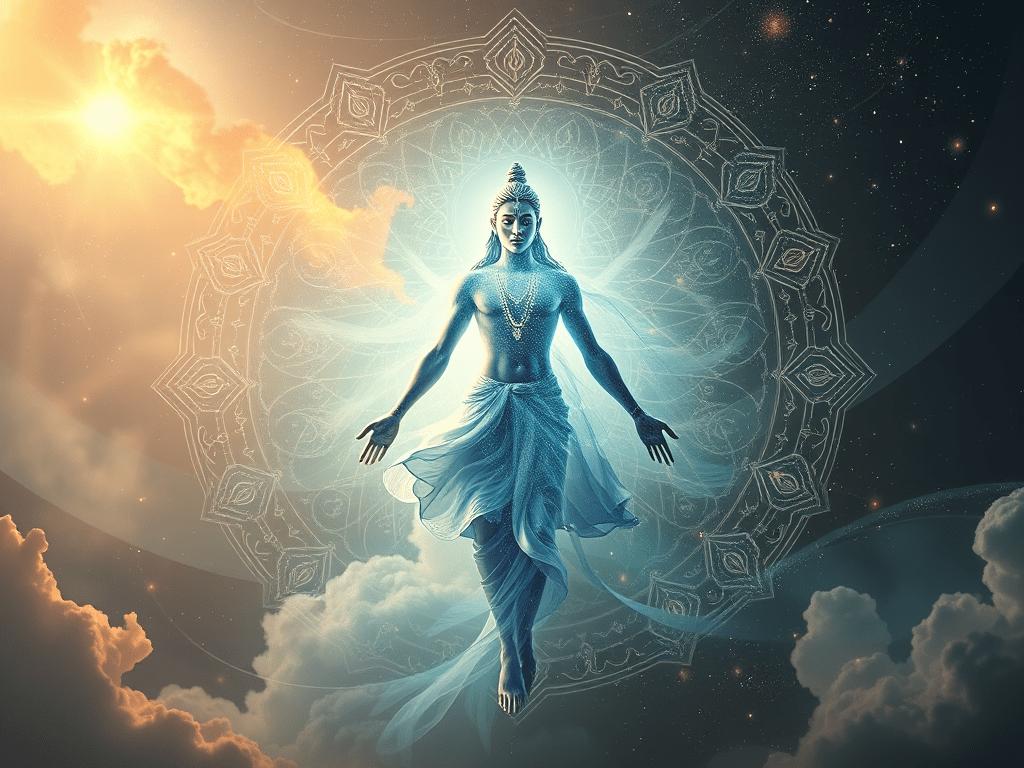
Among the world’s religious traditions, Hinduism offers perhaps the most explicit vocabulary for speaking of the eternal. Terms such as ātman, brahman, mokṣa, and saṃsāra point to a profound metaphysical intuition; one that comes remarkably close to glimpsing what the structure of Being makes necessary. Yet, as with all traditions, this truth often appears alongside forms of misinterpretation, shaped by the assumption of becoming and time.
At its heart, Hinduism teaches that ātman, the innermost self, is not separate from brahman, the unchanging ground of all reality. This unity is not reached through a process in time but is already the case; eternally so. The journey of the soul through saṃsāra (birth, death, and rebirth) is often understood as a cycle to be escaped through liberation (mokṣa). Yet the very notion of liberation from the cycle, when taken literally as a goal to be attained through temporal effort, obscures the fact that if Being is truly eternal, then no soul could ever be trapped in time to begin with.
Thus, the metaphysical core of Hinduism: the unity of all things, the illusion (māyā) of separateness, the stillness beyond action, is not in contradiction with the eternal structure of reality. Rather, it is a deeply symbolic unveiling of it. What is needed is not to discard these symbols, but to read them in light of what is necessary: that the eternal cannot begin, that no self is born or dies, and that what appears as time is the necessary appearing of what never was in time to begin with.
Symbols of Eternity: The Core Concepts of Hindu Metaphysics
Ātman and Brahman
In the Upaniṣadic tradition, ātman, the self, is declared to be brahman, the absolute. This is among the most direct affirmations in religious history of what Severino names the structure of Being: that all that is, is eternal, and that nothing truly separate, fragmentary, or contingent exists. Ātman is not a temporal ego moving through experiences; it is the luminous, unchanging essence of what is. And brahman is not a god among others, but Being itself, infinite and indivisible. The misinterpretation arises when this identity is understood as a state to be achieved or realized through time. In truth, the eternal identity of ātman and brahman is not a future attainment, but a necessity. What is, cannot not be; and what ātman is, it eternally is.
Mokṣa
Liberation (mokṣa) is often conceived as an end state, reached after many cycles of rebirth. But to the extent that liberation is thought of as a change, it still operates within the logic of becoming. If liberation were the result of time, then it would also be subject to time, and thus not liberation at all. The true liberation is not the end of becoming, but the recognition that becoming never truly was. What appears as a journey is the necessary unfolding of the truth that no self has ever been imprisoned. The truth of mokṣa is not escape, but unveiling.
Saṃsāra
The cycle of birth and death, saṃsāra, is one of Hinduism’s most powerful symbols. Yet it is often misunderstood as a literal process undergone by the self. In truth, what appears as birth and death is the temporal expression of the eternal. The jīva, or individual soul, is not a temporal entity trapped in causality, but an eternal appearing within the infinite structure of Being. What Hinduism intuits is that all change is illusion, but that illusion has its place within the order of what appears. Saṃsāra is not a trap from which the eternal escapes, but a veil through which it appears.
Karma
Karma, as action and consequence, is frequently viewed as the law that binds the self to saṃsāra. When understood within the framework of will, time, and becoming, karma seems to reinforce the illusion of a self in control of its destiny. But at a deeper level, karma is not the engine of time, but the symbolic expression of coherence. Every action reveals the structure of Being, not because of a causal link, but because what appears can only appear as ordered, meaningful, and intelligible. Karma is the echo of necessity in the symbolic language of life.
Not a Doctrine, but a Disclosure
Hinduism, more than perhaps any other tradition, lives within the tension between time and eternity. It speaks the language of multiplicity, myth, and motion, yet beneath this profusion lies a silent and unwavering glimpse of what is; not as an idea, nor as a goal, but as the necessity that nothing can escape.
The central intuition that ātman is brahman is not merely a theological claim. It is a metaphysical assertion that Being is one, undivided, and eternal. The manifold gods, the layered cosmologies, the intricate rituals, the epics of divine play, all serve, however dimly or dazzlingly, to reflect the impossible truth: that nothing that is can become what it is not, and nothing that is not can become. In this light, even saṃsāra, with all its apparent flux, becomes not the prison of existence, but the symbolic rhythm of the eternal’s self-disclosure.
The language of Hinduism is often read as metaphysical pluralism, but its deepest vision is not a multiplicity of truths, nor even a synthesis, but a silent ground prior to all opposition. Mokṣa is not the end of becoming, but the end of believing in it. Karma is not a mechanism of reward and punishment, but a reflection of the coherence of what necessarily is. And brahman is not a divine will, but Being itself; the unthinkable, the indivisible, the ever-present.
As with all sacred traditions, Hinduism has both concealed and revealed the eternal structure of reality. Its myths and metaphors may veil the truth in forms conditioned by time, desire, or fear, but these same forms, when read rightly, allow us to glimpse what does not begin, what does not pass away. Not as an exception to metaphysical truth, Hinduism stands as one of its most intricate witnesses; a vision of eternity appearing, always, within the garments of time.


Leave a comment