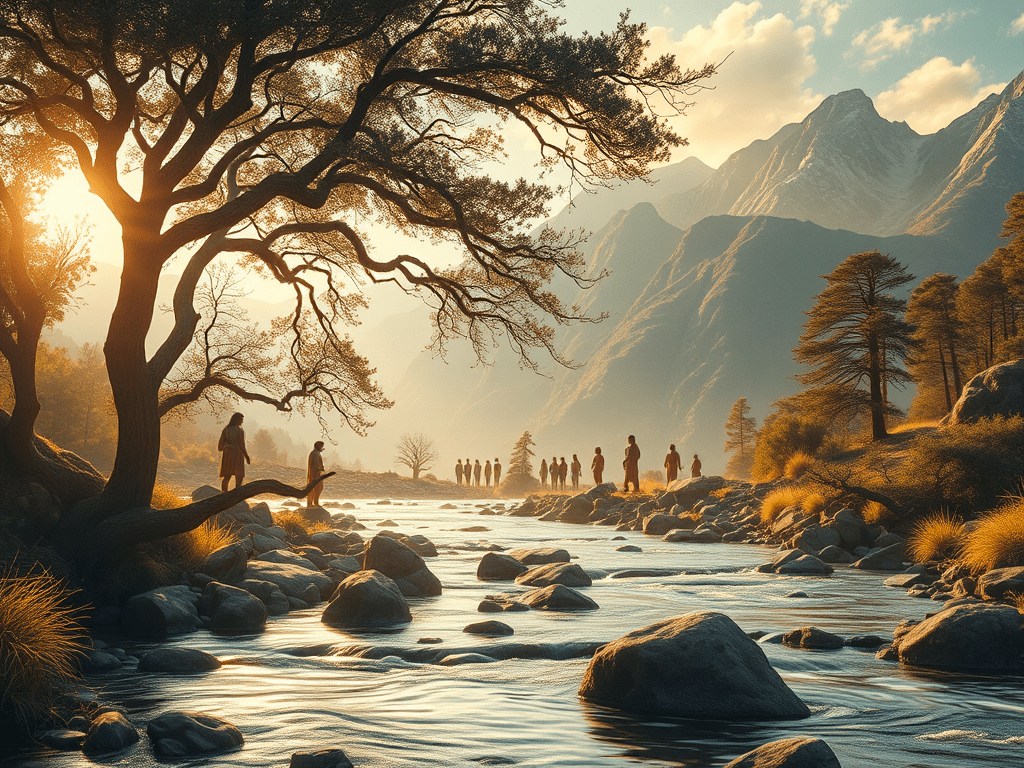
In the long and diverse lineage of human attempts to understand what lies beyond death, Indigenous and ancestral traditions form some of the most deeply rooted expressions of reverence for the eternal. These traditions – vast in number and varying in language, cosmology, and symbolism – tend not to formulate metaphysical systems in abstract terms, yet they often carry an intuitive insight into the permanence of what appears, even when it is veiled beneath the rhythms of time, nature, and ancestral memory.
This article is not an exhaustive survey of Indigenous worldviews, which are irreducibly plural and culturally situated. Rather, it is an attempt to listen to their recurring themes, to the presence they accord to the dead, the sanctity of place, and the cyclical unfolding of existence, and to ask what these might reveal about their relation to truth, eternity, and the afterlife. We will explore how these traditions can approach the eternal, even while remaining bound to certain temporal patterns that obscure the full recognition of what is.
The Presence of the Dead: Memory and Manifestation
Across Indigenous and ancestral traditions, death is rarely understood as disappearance. The dead remain present, not only in memory, but in the world itself. They inhabit the land, the wind, the river, the fire; they speak in dreams and omens; they are remembered not simply as having lived but as still living, still shaping the lives of the living.
In many African spiritual systems, for instance, the ancestors are part of a continuing communal life. They are not “past” but “elsewhere,” accessible through ritual, invocation, and reverent attention. In many Native American traditions, the spirits of the ancestors inhabit sacred places and participate in the cycles of nature. The same is true in Aboriginal Australian cultures, where the Dreamtime, though often described as a mythic “past”, is not a temporal moment at all, but an ongoing, always-present reality that sustains and orders the world.
These views do not merely preserve the dead in memory; they assume the persistence of their being. And while they often lack an explicit metaphysical vocabulary, they reveal a conviction that what appears, what has been, is not simply cast into nothingness. In this way, they witness, even if partially, to the impossibility of becoming and the permanence of every being.
The Sacredness of Place: Land as the Memory of Being
In Indigenous traditions, land is never neutral. It is not simply a resource, but a being, an ancestral presence, a witness, a teacher. Mountains, rivers, forests, stones: each holds memory, carries meaning, and is bound to the stories of those who lived, died, and returned to the earth.
The burial grounds of the dead are not closed chapters but active places of presence. The land is a record; not of what was, but of what is. The spiritual ecology of Indigenous life holds that the human and nonhuman world are not separate orders but share a mutual belonging. The eternal is not elsewhere; it is here, but not always seen.
This sacrality of place often includes cycles of renewal, death, and rebirth. Yet these are not always framed as annihilation and recreation, but as transformation within continuity. The seed does not vanish in the tree; the ancestor does not vanish in the child. In these images, there can be discerned a faint yet powerful sense that nothing that is can become nothing.
Still, this truth remains largely symbolic or intuitive. The land is revered, the spirits honored, the cycles observed, but the necessity of each being, its unrepeatable and unvanishing essence, is rarely made explicit. The eternity expressed here is participatory and communal, yet still appears through the rhythm of temporal recurrence.
The Cycle of Life: Time Without End?
One of the most common themes in ancestral traditions is the cyclical nature of time. Seasons turn, generations rise and fall, the moon waxes and wanes. Life is not linear but rhythmic. In this, these traditions often diverge from the Western tendency to imagine time as a progression toward an end, either a final judgment, a spiritual evolution, or the extinction of all things.
Instead, they present a world in which time repeats, in which the dead return in new forms, in which life is not “used up” but transformed. Reincarnation, ancestral return, and the renewal of life through death are common themes. The soul may reappear in a newborn; a warrior may be reborn in his descendant. There is, in this, a sense that nothing truly ends, that death is not a vanishing but a passage.
Yet this cyclical vision often retains a sense of movement, of process. The being of each one is not always seen as eternal in its precise identity, but as part of a broader continuity. The seed becomes the plant, the ancestor becomes the child, the fire returns to ash and rises again. In these images, we see a strong resistance to the nihilistic logic of becoming, yet also a lack of full recognition of the eternal structure of Being as immutable and unbeginning.
The cycle resists finality but still implies change. It suggests continuity but not always necessity. It affirms presence but not always identity. The truth of being is intimated but not yet fully unveiled.
Witnesses of Eternity, Bound by Time
In Indigenous and ancestral traditions, we find some of the most enduring testimonies to the non-disappearance of what is. The world is not seen as disposable; the past is not abandoned; the dead are not lost. There is a powerful fidelity to what has appeared—an unwillingness to let it be swallowed by forgetfulness or metaphysical nothingness.
And in this fidelity, these traditions bear witness. They preserve a sense of the eternal not through abstraction or doctrinal definition, but through reverence, ritual, and relationship. Their languages are not always philosophical, but they often reach closer to the heart of what is than many systems that claim precision.
Yet this witness remains veiled. The cyclical form still implies a becoming. The transformation of one into another can suggest that being is not irreducibly itself. The absence of a clear recognition of necessity leaves room for ambiguity. The eternal is sensed, but not yet seen as what must be, as what cannot not be.
Still, these traditions remind us of something forgotten by modernity: that life is not consumable, that death is not the end, and that every being, once appeared, leaves a trace that cannot be erased. In honoring the ancestors, in listening to the land, in remembering the sacred, they hold open the question of what truly is, and they do so not through argument, but through fidelity.
A Veiled Intuition of the Immutable
The Indigenous traditions do not aim at metaphysical finality. They do not always separate being from becoming, or ask whether what appears is necessary or contingent. Yet within their practices and stories, there often lives an intuition that nothing is truly lost, that the world is more than a flux of appearances.
What is missing is the affirmation that each being, each moment, each one, is necessary; that it does not become, but eternally is. Without this, the cycle remains bound to time; the presence of the dead remains a matter of belief or ritual, rather than the clear recognition of their eternal being.
But perhaps this is also their strength: they do not argue, they remember. They do not claim eternity; they honor it. And in doing so, they prepare the ground for a clearer seeing. They preserve the question, and by doing so, they preserve the possibility of its true answer.
They are, in this way, both veiled and luminous. Their silence speaks. Their fidelity points beyond itself. And in a world forgetful of eternity, they remain among the last who still remember that what is cannot become nothing.


Leave a comment