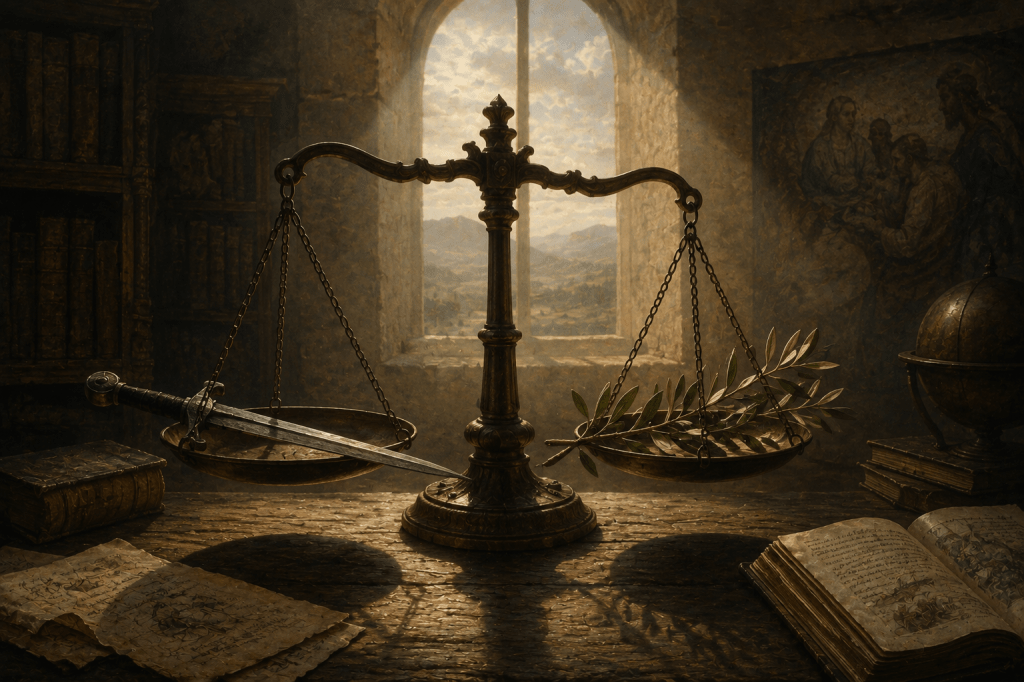
War and peace are among the oldest words in the human story.
They belong to every civilisation, every culture, and every generation. They shape our understanding of history, influence our hopes for the future, and often determine how we judge both ourselves and others.
We usually think we know what these words mean: war is conflict, and peace is its absence. Yet the more closely we look, the less certain those familiar meanings become.
History remembers periods of peace that concealed violence beyond their borders, while moments of remarkable humanity have often appeared in the midst of war itself. The realities we call war and peace seem, at times, to exceed the definitions by which we ordinarily understand them.
This series begins with that simple observation.
Not in order to redefine war or to propose a new programme for peace, but to look again at experiences that are already familiar to us. Rather than moving quickly toward conclusions, we shall remain with ordinary human life long enough for it to disclose questions that often pass unnoticed.
Along the way we shall encounter the will to act, the growth of technique, the movement of history, the search for security, the experience of loss, and the quiet recognition of realities that seem to remain present through every historical change. None of these themes stands apart from the others. Each gradually opens onto the next, inviting us to widen the horizon within which the previous one was understood.
The reflections that follow do not ask the reader to accept a particular philosophical system or religious tradition. They ask only for the willingness to look patiently at what is already present, and to consider the possibility that reality may be richer than our first interpretations allow.
If, by the end of this journey, war and what we ordinarily call peace appear differently than they did at the beginning, then the purpose of these pages will have been fulfilled.
For perhaps the deepest questions are not answered by looking elsewhere.
Perhaps they begin when we learn to look again.


Leave a Reply