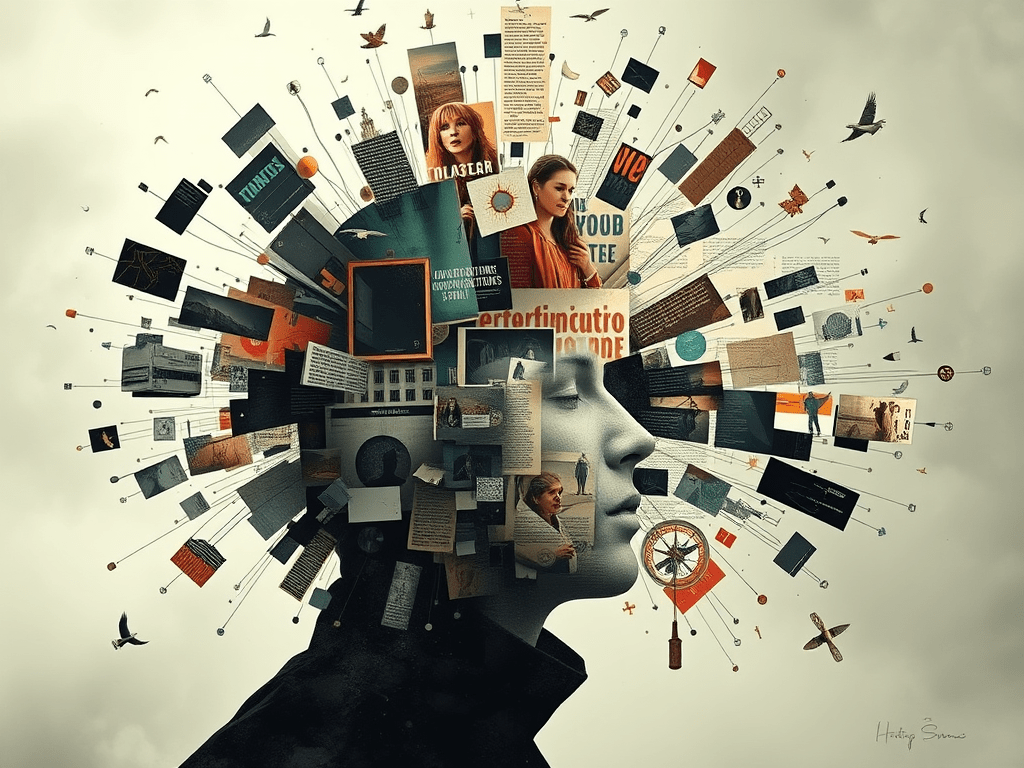
To understand why truth has become so problematic, we need to look at a profound shift in how reality itself has been understood in recent decades. This shift is often gathered under the broad and somewhat vague label of postmodernism.
Postmodernism did not begin as an attack on truth. It emerged as a reaction to something very real: the collapse of confidence in grand narratives. The twentieth century had shown how appeals to absolute truth could be used to justify violence, oppression, and ideological rigidity. Science, religion, and political ideologies alike had promised certainty and delivered catastrophe. Suspicion became reasonable.
As a result, thinkers began to question whether truth was ever neutral. They asked who benefits from a claim to truth, whose voice is excluded, and how language itself shapes what can be said. Attention shifted from reality to discourse, from what is to how things are described. Truth was no longer seen as something discovered, but as something produced.
This was an important insight. It exposed the hidden assumptions, power structures, and exclusions embedded in supposedly objective claims. It showed that knowledge is never completely detached from history, culture, and language. In that sense, postmodernism performed a necessary critical function.
But the shift did not stop there.
Gradually, truth itself was redefined. No longer something that concerns reality, it became something that belongs to perspectives. Instead of asking whether a statement is true, we began to ask whose truth it is. Instead of seeking what is shared, we learned to emphasize difference. Reality fragmented into narratives, each valid within its own context, none allowed to claim priority.
The familiar phrase “everyone has their own truth” captures this perfectly. It sounds tolerant and generous, but it hides a deeper assumption: that there is no longer anything for truths to be about. What remains are interpretations without a common referent.
At first glance, this seems to promote openness. In practice, it creates a paradox. If all truths are equally valid, on what grounds can we criticize injustice, manipulation, or harm? If truth is always relative to a framework, why should one framework be preferred over another? Why should inclusion matter more than exclusion, or care more than indifference?
Postmodernism often answers by appealing to ethics or empathy. But this appeal already presupposes something stable and binding. It assumes that suffering matters, that domination is wrong, that some claims should not be tolerated. These are not mere preferences. They function as truths, even when the language of truth has been abandoned.
This is why postmodern relativism is not the absence of absolutes, but their displacement. Absolute truth is rejected at the level of theory, yet quietly reinstated at the level of values. The result is a tension that runs through much of contemporary discourse. We deny truth in principle, but demand it in practice.
This tension also explains why disagreement has become so fraught. When there is no shared reality to appeal to, disagreement cannot be resolved through understanding. It becomes a clash of identities. To challenge a claim is no longer to question an idea, but to threaten a person or a group. Defensive reactions are not accidental. They are structurally built into a world of isolated perspectives.
None of this means that postmodernism was simply a mistake. It revealed real problems in earlier conceptions of truth. It dismantled naïve objectivism and exposed the role of power and language. But in dissolving truth into perspectives, it also removed the very ground on which critique stands.
In the next post, we will explore what happens when truth no longer serves as a shared reference point, and why emotions, rather than arguments, begin to dominate both personal and public life.


Leave a comment