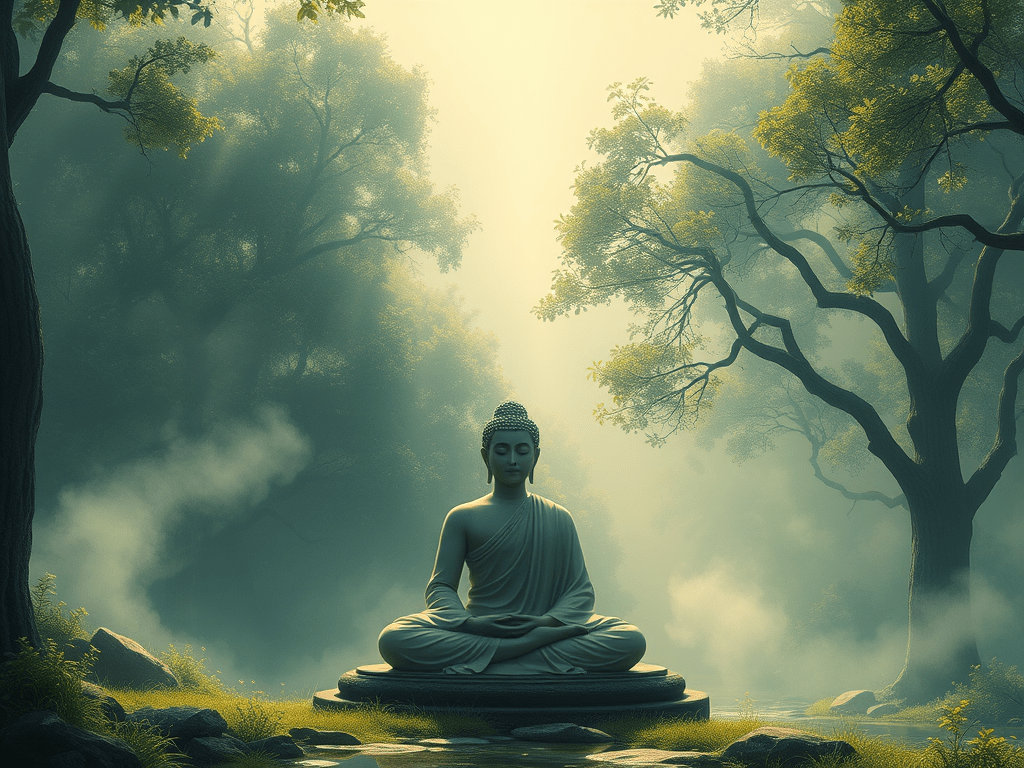
Among the world’s spiritual traditions, Buddhism speaks with unmatched clarity about the impermanence of things. It does not begin from a creator, a soul, or a promise of eternal life. Instead, it begins from the simple, inescapable fact of suffering, and from the recognition that all that arises, passes away. Craving, impermanence, and illusion stand at the heart of its teaching. Yet far from nihilism, this vision conceals one of the most profound intuitions of eternity: that what is, cannot become what it is not, and that liberation lies not in the future, but in the ending of illusion itself.
And yet, as with all traditions, this glimpse into truth is accompanied by forms shaped by time, choice, and progression. The insight of Buddhism, that suffering arises from craving and ignorance, often takes on the form of a path, a gradual cessation, a realization reached through practice. What appears as negation of time may itself remain veiled by the language of process. Even Buddhism, with all its radical minimalism, still expresses the eternal through symbols conditioned by becoming.
Seeing Through the Illusion of Becoming
The Buddha’s great discovery is not a cosmology or theology but a diagnosis. Suffering (duḥkha) exists, he taught, and it arises from craving (taṇhā), which in turn arises from ignorance (avijjā). This ignorance is not a lack of information but a mis-seeing, the belief that the self is real, that what arises will last, that happiness can be found in what changes.
In this, the Buddhist vision echoes a deeper ontological claim: that becoming is illusion. What seems to come into being and pass away cannot truly be. That which truly is cannot become what it is not. Duḥkha, then, is not merely pain, it is the friction of the impossible. It is the suffering that arises from mistaking appearance for substance, becoming for Being.
The teaching of dependent origination (pratītyasamutpāda) shows how phenomena appear in relation, not isolation. But this web of conditions is not a causal engine of becoming; it is a veil, an ordered display of illusion. As long as one sees the world as arising and passing away, one remains caught in what appears rather than in what is.
In this sense, Buddhist thought, especially in its more radical Mahāyāna expressions, can be seen as a sustained attempt to unmask the impossibility of becoming. The doctrine of no-self (anātman) strikes directly at the illusion of the enduring individual. The concept of emptiness (śūnyatā) reveals the absence of any self-sustaining substance. The highest freedom (nirvāṇa) is not a place or a state but the extinguishing of illusion itself.
The Persistence of Temporal Symbols
Yet even these profound insights, when cast into forms of instruction, take on the shape of time. The Four Noble Truths speak of a path to be walked. The Eightfold Path unfolds as a sequence of actions and states. Meditation is prescribed, realization expected, cessation described as a future event. Though the Buddha insisted that awakening is not an acquisition, the language of practice implies a progression.
Here, as in other traditions, what is glimpsed as eternal becomes framed as a process. Nirvāṇa is described as the “end” of suffering, as if it were something that occurs after a period of purification. The self is said not to exist, and yet the illusion of the self must be undone, step by step. Even when realization is said to be sudden, it remains described as something that happens. But if what is eternal cannot begin, then no realization can bring it about. It must always already be.
Thus, the Buddhist tradition, while penetrating the illusion of becoming more clearly than most, still expresses this insight within the appearance of time. The very idea of “overcoming ignorance” implies a movement from not-knowing to knowing. But ignorance is not a phase; it is the appearance of temporality itself. The eternal cannot arrive. The truth of what is, if it truly is, was never absent.
No-Self and the Unveiling of Being
The doctrine of anātman is perhaps Buddhism’s most radical rejection of metaphysical illusion. In denying the existence of an enduring self, it breaks with the common religious claim that something personal survives death. Yet this denial does not lead to annihilation, because it never affirms that anything was annihilated. The self that suffers is the self that imagines it was born.
Still, if the self does not exist, who walks the path? Who attains awakening? Buddhism often responds that these are merely conventional designations. But the language of designation, too, rests on an implicit temporality. Even to speak of illusion as something to be “seen through” implies a change.
This is the subtle contradiction: Buddhism denies the reality of time, but its own path unfolds in time. It teaches that nirvāṇa is not caused, not conditioned, not temporal, yet it is reached through temporal practices. The goal is timeless, but the means are bound to time.
What would it mean, then, to read Buddhism not as a gradual journey to freedom, but as a symbolic unveiling of the fact that no self has ever been bound? That nirvāṇa is not a cessation that happens, but the appearing of what was never in flux to begin with? That even suffering, even craving, even delusion, while appearing as movement, are the necessary appearance of what is always already complete?
A Tradition of Veiled Clarity
This is where Buddhism stands: at the edge of history, looking through the illusion of becoming, yet still speaking the language of time. It strips away gods, creation myths, eternal souls, and yet what remains is not nothing, but the structure that makes even nothingness intelligible.
The image of the bodhisattva, who postpones final awakening to help others, is not just an ethical figure; it is a symbol of the eternal veiled in compassion, the necessary revealing of what is within the forms of what seems to happen. The silence of Zen, the suddenness of satori, the radiant emptiness of Mahāyāna; these are not doctrines, but gestures. They point toward what cannot not be, while refusing to say it.
But even here, the refusal is still a veil. The eternal cannot be evaded by silence any more than by speech. To say nothing is still to appear in time. The illusion of temporality cannot be escaped by renunciation, only recognized for what it is.
Closing Reflection
Buddhism, then, stands neither above nor apart from the other great traditions. It shares with them the tension between insight and veil, between eternity and time. It sees deeply into the impossibility of becoming, yet often casts that insight in the language of path, discipline, and arrival. It unveils the illusion of self, yet still teaches the steps by which that illusion is overcome.
And yet, for all that, its central gesture remains one of extraordinary power: to unmask the suffering that arises from believing in change. To name craving, not as moral failure, but as a metaphysical confusion. To glimpse that what is most real was never born and will never pass away.
Like the others, Buddhism is not an exception to metaphysical truth, but a witness to it; one shaped by silence rather than proclamation. Its denial of becoming is not an emptiness, but a clearing. And in that clearing, the eternal structure of Being (what cannot begin, cannot end, and cannot not be) becomes visible, if only for a moment, before vanishing again into the forms of time.


Leave a comment